Mertensophryne melanopleura: Exploring the Secret Lives of Africa’s Forest Toads#
In the quiet, mist-draped forests of eastern Africa, a hidden world thrives beneath tangled roots, damp leaves, and lush mosses. Amidst this often-unseen microcosm moves an elusive resident: the Black-sided Forest Toad, scientifically known as Mertensophryne melanopleura. Unremarkable at first glance yet fascinating upon deeper exploration, this small, secretive amphibian serves as an enchanting ambassador of subtropical biodiversity.
Though seldom featured in wildlife documentaries or colorful coffee-table books, Mertensophryne melanopleura captures the imaginations of those fortunate enough to encounter it. Characterized by its distinctive coloration—a subtle elegance of black flanks and mosaic patterns—this toad invites us to take a closer look at the intricate tapestry of life hidden within African woodlands. But this species is more than mere aesthetics: its existence is deeply tied to the health of its forest habitat and serves as a sentinel for ecological changes. Dive with me into a journey through subtropical forests, experiencing firsthand the fascinating story of this remarkable amphibian.
Taxonomy and Classification#
Mertensophryne melanopleura falls within the family Bufonidae, commonly known as true toads. Within this vast family reside diverse genera, each adapting remarkably to their unique environments. The genus Mertensophryne consists of species notable for their relatively small sizes and cryptic lifestyles. First described scientifically in 1905 by German zoologist Gustav Tornier, M. melanopleura has fascinated herpetologists ever since with its behaviors and subtle adaptations.
Its genus name, “Mertensophryne,” honors renowned herpetologist Robert Mertens, who dedicated his career to studying amphibians and reptiles. Within its group, Mertensophryne melanopleura is closely related to other African forest toads, such as Mertensophryne micranotis. Each species in this genus shares a suite of characteristics that optimize survival in shaded and densely vegetated forest floors—a testament to evolutionary pressure shaping their subtle uniqueness.
Natural Habitat#
The Misty Sanctuaries of Eastern Africa#
The Black-sided Forest Toad calls the rich, humid forests of eastern Africa home, specifically occurring in select localized regions throughout Tanzania and parts of Kenya. These toads are intimately associated with subtropical or tropical moist lowland forests, often nestled comfortably within leaf litter, beneath decaying logs, or tucked under thick mats of moss—small microhabitats breached only by scattered sunlight.
Imagine a place where morning fog gently lifts, giving way to dappled patches of golden sunlight. The air hums with insect diversity, and the forest floor pulses invisibly with life. This humid, leaf-shrouded ecosystem provides essential moisture retention and abundant prey—two critical resources that define the daily ecology of the Black-sided Forest Toad. Quite vulnerable to desiccation, these amphibians rely heavily on these humid microclimates, emphasizing the interconnected importance of intact forest ecosystems.
A Habitat Dependent Species#
The forest floor is far more than a mere backdrop for the daily adventures of Mertensophryne melanopleura; it is the canvas on which their survival depends. Leaf litter and decaying organic matter harbor countless invertebrates such as tiny beetles, springtails, mites, and larvae, providing ample nutrition for these small amphibians. Likewise, the reliable moisture below leaf layers maintains their skin hydration, crucial for their sensitive skin that aids respiration.
Ultimately, the role of forest ecosystems extends beyond mere survival—it is integral for successful reproduction. Breeding sites, primarily small water-retaining pools formed in tree cavities, shallow puddles, and ephemeral streams, are vital for larval development. As such, the life cycle of Mertensophryne melanopleura intertwines closely with rainfall patterns and healthy forest hydrology.
Physical Characteristics#
Beauty in Subtlety#
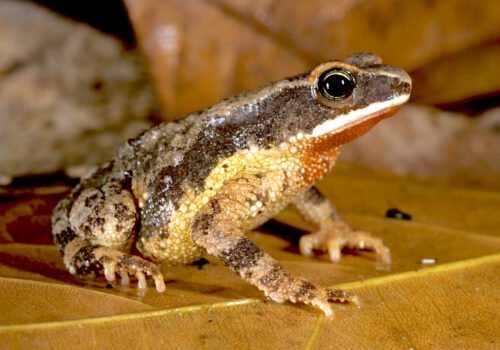
Measuring no more than three to four centimeters, the Black-sided Forest Toad may not immediately catch the eye. Its coloration is quiet and discreet: shades of brown or olive, splashed occasionally with darker notes. The most defining physical feature from which it derives its scientific epithet “melanopleura” (meaning dark-sided) is the prominent black patches along its flanks. Upon close examination, tiny granular glands cover its warty skin, delivering protection by secreting mild toxins to dissuade predators—a sophisticated yet understated defense mechanism.
Anatomy for Survival#
Like other Bufonidae members, they possess compact bodies built for maneuvering through tight spaces. Short and powerful hind legs excel at swift hops and agile movements amid cluttered forest grounds. Additionally, the mildly camouflaged appearance assists in blending seamlessly with the mottled patterns of leaf litter and bark. Each subtle trait of anatomy contributes precisely to an existence of quiet stealth, vital for both predator avoidance and effective prey capture.
Behavior and Life Cycle#
Subtle Hunters on the Forest Floor#
At dusk, as daylight fades and the forest transforms into an orchestra of nocturnal melodies, the Black-sided Forest Toad emerges from daytime hiding to hunt. Their primary diet of leaf litter insects is abundant, and they adeptly use ambush tactics to catch prey. These amphibians patiently remain immobile, waiting for unsuspecting insects to come within striking distance. A swift, precise flick of a sticky tongue seals the prey’s fate—a quiet drama in miniature scale acted nightly on the shadowed stage of the forest.
The Delicate Dance of Reproduction#
Mating season coincides with periods of increased rainfall. Males gather near water bodies, emitting soft, repetitious calls to attract potential female mates—a gentle chorus that barely stands out amidst the forest’s rhythmic hum. Upon selection by a female, amplexus—a form of mating embrace common among amphibians—follows, with fertilized eggs laid in carefully selected shallow waters that promise protection and resources to emerging tadpoles. Larval development occurs in temporary forest pools, where tadpoles rapidly mature before pools dry, underscoring their intricate adaptation to seasonal forest dynamics.
Ecological Role#
Mertensophryne melanopleura, though modest in stature and easily overlooked, fulfills critical functions within its ecosystem. Predation upon forest-floor insects and other small invertebrates naturally contributes to population control, preventing excessive outbreaks and sustaining biodiversity balance.
Conversely, these small toads serve as essential prey for larger predators, including birds, small mammals, and reptiles; thus, they form integral links within complex forest food webs. Furthermore, their susceptibility to fluctuations in moisture levels and declines in invertebrate prey makes them timely indicators of environmental health, offering researchers a nuanced insight into the overall conditions within subtropical forests.
Threats and Conservation Status#
Currently, Mertensophryne melanopleura is classified by the International Union for Conservation of Nature (IUCN) as Least Concern due to its relatively wide distribution and presumed stable populations. Nevertheless, conservationists exercise cautious optimism. These amphibians’ heavy reliance on intact forest habitats underscores their vulnerability to habitat disturbance, degradation from agriculture, logging, climate change-induced rainfall variability, and pollution.
Earlier detection of these subtle threats and mitigation strategies will be paramount in preventing population declines. Conservation efforts have primarily advocated habitat preservation, alongside the local community education and sustainable land use practices, demonstrating that an inclusive, collaborative approach can safeguard not only the species but also the ecological integrity of the entire forest landscape.
Cultural and Scientific Significance#
While the Black-sided Forest Toad rarely occupies central narratives in local folklore, amphibians overall hold strong symbolic significance within various African cultures as bringers of rain, fortune, fertility, or, conversely, omens of illness. Such associations underline the integral role amphibians play in shaping cultural landscapes and heralding changing natural patterns.
Scientifically, amphibians such as Mertensophryne melanopleura contribute invaluable data for ecologists and climate scientists. Their sensitivity makes them biological sentinels, and studying their resilience or vulnerability provides clues into ecosystem health and adaptation strategies amidst global climate shifts.
Conclusion#
Amidst the hushed whispers of African subtropical forests, a small, unassuming amphibian dwells—a reminder of the extraordinary hidden within the ordinary. Mertensophryne melanopleura, the Black-sided Forest Toad, eloquently illustrates nature’s understated elegance and ecological interconnectedness.
As we glimpse into their secretive lives, let us also acknowledge their intrinsic worth, appreciating not only their role in securing ecological balance but consequently the urgent necessity to conserve the magnificent, fragile ecosystems they occupy. Let the story of this humble creature inspire a deeper connection, meaningful stewardship, and fervent conservation advocacy.