- Mertensophryne loveridgei: The Enigmatic Toad of Tanzania's Eastern Arc Mountains
- Taxonomy and Classification of Loveridge's Forest Toad
- The Serene, Fog-Kissed Habitats of the Eastern Arc Mountains
- Physical Characteristics: Camouflage among the Leaf Litter
- Behavior and Extraordinary Life Cycle
- Ecological Influence: A Vital Cog within Forest Ecosystems
- Conservation Status: A Species Struggling for Survival
- Cultural and Scientific Connections
- Conclusion: Preserving an Icon of Tanzania’s Hidden Forest Realms
Mertensophryne loveridgei: The Enigmatic Toad of Tanzania’s Eastern Arc Mountains#
Deep within the lush, undulating forests blanketing Tanzania’s Eastern Arc Mountains resides an unassuming yet uniquely captivating amphibian, quietly thriving amidst leaf litter, moss-covered rocks, and ancient tree roots. Mertensophryne loveridgei, colloquially known as Loveridge’s forest toad, occupies a special niche—both ecological and cultural—within East Africa’s rich tapestry of biodiversity. Distinguished by its reclusive nature and striking yet cryptic appearance, this diminutive toad has fascinated herpetologists and captured the imagination of wildlife enthusiasts around the globe.
Though small and secretive, Mertensophryne loveridgei embodies the very essence of ecosystem complexity, an emblematic symbol of conservation needs. Amid unprecedented environmental shifts, understanding—and indeed protecting—such enigmatic creatures has never been more crucial. Journey with us on an intimate exploration of the remarkable life, unique adaptive strategies, and the pressing conservation realities faced by this Tanzanian treasure.
Taxonomy and Classification of Loveridge’s Forest Toad#
Loveridge’s forest toad belongs to the Bufonidae family, more commonly known as “true toads.” Within this diverse group, the genus Mertensophryne comprises species primarily distributed throughout East Africa, specialized to life in transitional habitats often bridging wet forests and drier woodland. Officially described in honor of prolific British herpetologist Arthur Loveridge in 1932, the scientific name Mertensophryne loveridgei pays homage to his contributions to amphibian taxonomy and field herpetology throughout East Africa.
Taxonomically classified as:
- Family: Bufonidae (True Toads)
- Genus: Mertensophryne
- Species: Mertensophryne loveridgei
Closely related species within the genus share similar morphologies and characteristics, adapted distinctly for life amidst forest leaf litter and rocky habitats. This specialization provides valuable insights into evolutionary adaptations in East African amphibians.
The Serene, Fog-Kissed Habitats of the Eastern Arc Mountains#
Geographic Range#
The geographic distribution of Mertensophryne loveridgei is limited and highly specialized, primarily found within the montane forests of Tanzania’s Eastern Arc Mountains. This mountain chain, consisting of isolated ranges such as the Uluguru, Usambara, and Udzungwa mountains, has served as an evolutionary cradle, supporting remarkable biodiversity often compared to the Galápagos Islands.
Ecological Preferences and Habitat Specialization#
Within these mist-covered ranges, Loveridge’s forest toad favors habitats dominated by closed-canopy evergreen forests, often located at mid to high elevation between 600 and 1,800 meters. Here, relentless rains and pervasive mist create a perpetually moist environment—an ideal setting that supports this species’ preference for leaf litter layers and rocky microhabitats fringed with ferns, mosses, and lichens.
The microclimate beneath the dense foliage offers consistent humidity and stable temperatures, essential elements for amphibian respiration, hydration, and skin integrity. The intricate vegetation and forestry ecosystems in turn protect them from larger predators and offer abundant insect prey. How profoundly nature connects here becomes apparent upon stepping into these forests—a soft hum of insects, distant birdcalls, a sudden scuttle of hidden life—and quietly among them, shrouded in soft greens and browns, sits this toad, patiently concealed.
Physical Characteristics: Camouflage among the Leaf Litter#
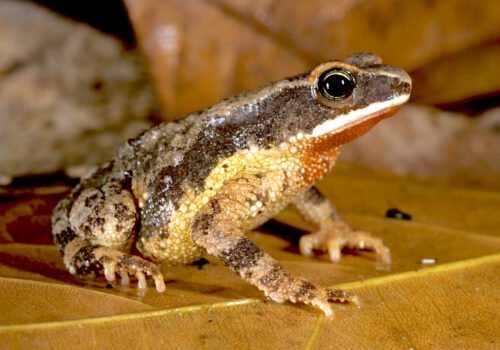
Mertensophryne loveridgei demonstrates remarkable cryptic coloration and texture, traits closely tied to its secretive lifestyle in these forests. Adults typically range in size from approximately 25 to 35 millimeters—smaller than the palm of your hand—displaying skin mottled subtly in shades of earthy browns, soft greys, olive greens, and gentle russets. This mosaic of earth-toned colors perfectly emulates leaf litter, moss-covered stones, and decaying vegetation, providing effective camouflage against avian predators and larger ground predators.
A closer inspection reveals pronounced parotoid glands situated behind each eye—characteristic of most true toads. These glands secrete mild alkaloid toxins as an added protection against predation. Their bumpy, warty-looking skin texture, though rough to appearance, actually retains moisture effectively—enabling prolonged periods of immobility without dehydration.
Eyes large and golden, pupils horizontal; each physical characteristic tellingly reveals adaptation derived through countless generations spent evading predators and patiently awaiting prey beneath forest floor debris.
Behavior and Extraordinary Life Cycle#
Nocturnal Life and Dietary Habits#
Loveridge’s forest toad epitomizes a nocturnally adapted predator. By day, individuals shelter inconspicuously beneath thick layers of fallen leaves, within crevices between tree roots, or nestled amid rocks cloaked in mosses. Come nightfall, under curtains of forest darkness pierced by shafts of pale moonlight, these enigmatic hunters awaken.
Insects provide primary sustenance—small beetles, caterpillars, ants, termites, and soft-bodied invertebrates abundant on humid forest floors. Toads rely predominantly upon their keen vision and motion sensitivity, utilizing quick lunges and sticky tongues to capture prey deftly in a fraction of a second.
Breeding Behaviors and Tadpole Development#
Reproduction in Mertensophryne loveridgei aligns with Tanzania’s rainy seasons. Heavy rains signal breeding activities, whereby males vocalize a soft yet persistent mating trill, resonating gently through humid forests. Females respond discreetly, joining potential mates in temporary rain pools or forest stream edges, facilitating egg deposition directly into water.
Tadpoles develop swiftly amidst submerged vegetation and nutrient-rich detritus. Typically cryptic, tadpoles themselves boast dark, subtle coloration, and rapidly mature to metamorphose into terrestrial juveniles gradually retreating once more into secret forest habitats. The delicate dance of this amphibian life cycle remains intricately intertwined within the rhythm of these forest seasons.
Ecological Influence: A Vital Cog within Forest Ecosystems#
Though small, Mertensophryne loveridgei substantially impacts its surrounding ecosystem. Serving as an essential insect predator, it significantly contributes to regulating prey populations and maintaining ecological balance. Moreover, this toad contributes to nutrient cycling by consuming decomposing invertebrates and redistributing nutrients back into the soil—an unseen yet vital ecological service underpinning forest health.
In turn, these toads offer nourishment for a variety of predators including small mammals, snakes, and birds, reinforcing their position as critical connectors in complex local food webs.
Conservation Status: A Species Struggling for Survival#
The International Union for Conservation of Nature (IUCN) currently classifies Mertensophryne loveridgei as “Vulnerable” due to its restricted range, fragmented subpopulations, and ongoing habitat loss. Deforestation for agriculture, timber extraction, charcoal production, and human settlement expansion collectively obliterate precious breeding habitats and refuge areas for this forest specialist.
Climate change further threatens them through altered rainfall patterns, unpredictable wet seasons, and shifting temperatures—disrupting breeding schedules and shrinking vital wetland habitats.
Cultural and Scientific Connections#
Beyond ecological significance, Loveridge’s forest toad represents meaningful cultural symbolism in Tanzania. Amphibians often indicate ecosystem health; thus, local communities consider this species a sentinel of forest richness. Scientists, too, value them for unique toxins with biomedical potential.
Conclusion: Preserving an Icon of Tanzania’s Hidden Forest Realms#
Mertensophryne loveridgei epitomizes the delicate beauty of shared connection among organisms and ecosystems. Protecting these ancient forest ecosystems wherein they silently dwell not only safeguards their own existence, but also defends countless interconnected species reverberating through the Eastern Arcs.
If you feel inspired, join communities dedicated to biodiversity conservation. Understanding and conserving such enigmatic amphibians enriches planetary health and our responsibility toward conserving Earth’s extraordinary, secretive wildlife like Loveridge’s forest toad—an integral, wondrous component of nature’s tapestry.