Introduction#
Hidden deep within the leaf-littered floor of East Africa’s ancient forests dwells a creature whose very existence epitomizes the delicate balance of nature. Mertensophryne lindneri, commonly known as Lindner’s dwarf toad, is an elusive amphibian whose reclusive habits and unique appearance enchant only the most observant of naturalists. Named in honor of its discoverer, this amphibian is tiny yet profoundly significant, serving as a crucial indicator of forest health. Although easily overlooked, these miniature toads offer remarkable insights into biodiversity and the ecological complexities of pristine habitats.
The moment you grasp a glimpse of this diminutive creature, you truly appreciate the profound wonder nature holds. With each leap, Mertensophryne lindneri navigates the tangled roots and moist leaf litter with delicate precision, reminding us of the extraordinary hidden worlds thriving quietly beneath our feet.
Taxonomy and Classification#
Mertensophryne lindneri belongs to the family Bufonidae, commonly known as true toads. Within this diverse family lies the genus Mertensophryne, which includes small, cryptic toads primarily native to sub-Saharan Africa. Scientifically described by Mertens in 1955, honorary tribute was given through the species epithet ‘lindneri’. Among its closest relatives are similarly adapted dwarf toads characterized by their small size, cryptic coloration, and secretive behaviors.
While sharing traits with other species within Bufonidae, Lindner’s dwarf toad showcases uniquely adapted features, particularly in its morphology and ecological niche. Understanding its taxonomic position sheds valuable light on evolutionary adaptations, allowing conservationists and naturalists greater clarity in protecting habitats essential for these unique amphibians.
Natural Habitat#
A Home in Subtle Seclusion#
The story of Mertensophryne lindneri unfolds predominantly under the shaded canopy of eastern Tanzania’s moist montane forests. Nestled primarily among leaf litter, beneath rotting logs, and in damp crevices, Lindner’s dwarf toad thrives in microhabitats characterized by high humidity and constant moisture. These frogs rarely venture far from their secluded hiding places, perfectly adapted to the delicate, humid layer beneath the forest canopy.
During the rainy season, when streams swell and forest floors become saturated, Lindner’s dwarf toad emerges more actively, becoming a participant in the vibrant, nocturnal symphony of amphibian life. It prefers elevations between approximately 500–800 meters, forests rich in indigenous vegetation, and environments less disturbed by human activity, relying heavily on the ecosystem stability these habitats provide.
An Intricate Web of Habitat Relationships#
The delicate balance required by M. lindneri emphasizes its sensitivity to environmental changes. Moist leaves and rotting logs form microclimates essential for survival by not only providing shelter from predators, but also suitable breeding grounds for eggs and sanctuary for developing tadpoles. Leaf litter harbors vast populations of essential prey insects, whose presence supports the feeding and growth of this diminutive amphibian. Thus, Lindner’s dwarf toad’s survival is inextricably tied to the health of its forest home.
Physical Characteristics#
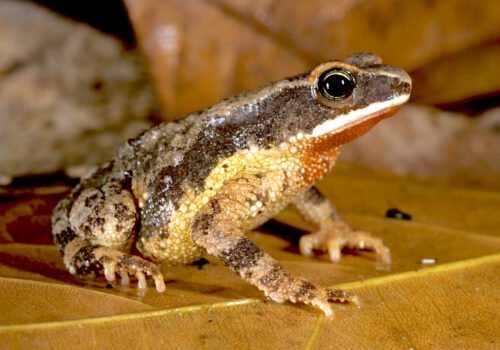
Mertensophryne lindneri is a small, charmingly cryptic amphibian typically measuring between 20–25 millimeters, roughly the size of your thumb’s tip. A marvel of natural camouflage, its rough, glandular skin sports shades ranging from subtle earthy grays, rich browns, to occasional splotches of yellowish or olive hues. The variability in color provides exceptional adaptability, enabling these tiny creatures to blend seamlessly with forest debris and moist soil.
Unlike more conspicuous amphibians, Lindner’s dwarf toad lacks vibrant hues, yet within its discreet coloration lies a profound beauty—a perfect example of evolutionary elegance. Each skin crevice, wart, and pigmentation pattern is evolution’s perfected artistry, enabling efficient moisture absorption and predator concealment.
Prominent parotoid glands positioned behind the eyes secrete a toxic alkaloid, providing an effective defense mechanism against would-be predators. Eyes, dark and reflective, protrude slightly, granting sharp peripheral vision—a necessary adaptation for detecting movements of predators and prey in a visually complex, shadowy environment.
Behavior and Life Cycle#
Nocturnal Hunts and Meticulous Feeding Habits#
Mertensophryne lindneri is primarily nocturnal, emerging from daytime shelters after sunset. As darkness settles over forests, they cautiously venture onto the forest floor, employing pinpoint-accurate leaps to navigate between feeding grounds. Their diet consists mainly of small insects found within the damp leaf layer—springtails, beetles, ants, and small arthropods constituting primary dietary components.
Using a sit-and-wait ambush mode of hunting, Lindner’s dwarf toad steadies itself amidst the damp leaves, remaining so still and inconspicuous that prey often foolishly crawls right into its grasp. A lightning-fast flick of the tongue ensnares the meal efficiently—a fleeting glimpse into the sublime orchestration of evolution adapting predators with precision hunting tools.
Breeding Season Secrets#
As seasonal rains pour down tropical canopy leaves, they signal the start of the breeding season for M. lindneri. The males’ high-pitched, faint calls—barely audible above the din of raindrops—reveal to listening females hidden rendezvous. Matched pairs engage in amplexus near temporary rain-filled pools, ponds, or depressions on the forest floor.
Females then deposit elongated gelatinous egg strands underwater or attached to submerged vegetation. Tadpoles, upon emerging from these delicate eggs, further deepen this amphibian’s fascinating life history, undergoing the remarkable transformation known as metamorphosis before taking their humble places among the forest leaf litter.
Ecological Role#
Though small, Mertensophryne lindneri performs critical ecological services. Predation on insects helps maintain arthropod population balance, indirectly aiding vegetation health and ecosystem stability. Likewise, these frogs are important food sources for birds, snakes, and mammalian predators within their habitat, linking various trophic levels together.
Perhaps greatest of all, Lindner’s dwarf toad is a sensitive ecological indicator, alerting scientists to ecosystem disturbances early enough to implement conservation strategies more effectively. Its presence—or ominous absence—clearly communicates the overall health of forest habitats.
Threats and Conservation Status#
Despite its unassuming nature, Mertensophryne lindneri faces significant environmental pressures. Deforestation, expanding agricultural areas, logging operations, and habitat fragmentation constitute primary threats, severely compromising the toad’s fragile habitat. Climate change further exacerbates this difficulty, altering rainfall patterns and disrupting stable cycles essential for survival.
Currently classified as “Least Concern” by the International Union for Conservation of Nature (IUCN), this status nonetheless belies ongoing risks requiring vigilance and proactive conservation. Local habitat preservation, sustainable forestry practices, and biodiversity monitoring are necessary strategies maintaining long-term viability.
Cultural and Scientific Significance#
Although rarely celebrated in cultural narratives—or the wider public’s consciousness—M. lindneri’s scientific value is unequivocal. The species offers insights into forest ecosystem functioning, identifying critical thresholds of environmental degradation. Moreover, alkaloids and biochemical compounds secreted by this species might hold promise for future medical applications and research, showcasing untapped natural biological innovations.
Cultural connection also arises for local communities who embed respect for frogs and other amphibians within broader environmental stewardship traditions, reflecting societies’ innate recognition of wildlife as integral, interconnected parts of their worlds.
Conclusion#
Mertensophryne lindneri, quiet and diminutive, embodies an extraordinary story of adaptation and resilience. To encounter this species amid Tanzania’s lush forests offers privileged glimpses into the incredible intricacy and wonder of nature’s designs. Yet, the window to protect and preserve its hidden world grows ever narrower.
As stewards of biodiversity, we must advocate conscientious conservation, ensuring the thriving survival of species such as Lindner’s dwarf toad. Together, informed and passionate, we can secure pathways toward impactful conservation—preserving wilderness treasures flourishing secretly beneath our feet for future generations.