- Mertensophryne howelli: Exploring the Secret Life of Howell’s Forest Toad
- Taxonomy and Classification
- Natural Habitat: A Hidden World Beneath the Canopy
- Physical Characteristics: Masters of Camouflage and Adaptation
- Behavior and Life Cycle: Quiet Lives Enriched by Complexity
- Ecological Role: Integral Threads in Forest Fabric
- Threats and Conservation Status: Guarding Nature’s Hidden Treasure
- Cultural and Scientific Significance: Frogs as Natural Messengers
- Conclusion: Recognizing Our Shared Responsibility
Mertensophryne howelli: Exploring the Secret Life of Howell’s Forest Toad#
Tucked discreetly amid the lush greenery of East Africa’s forests, a tiny amphibian thrives quietly, largely unnoticed amidst the flamboyant diversity around it. Its cryptic presence paints a compelling portrait of nature’s intimate dramas, unfolding beneath layers of decaying leaves and damp moss. This inconspicuous character is the intriguing Howell’s Forest Toad, scientifically christened Mertensophryne howelli.
Hidden from casual observers, this frog species connects ecosystems and signals the silent alarm of environmental change. Few creatures exhibit such quiet resilience, making this diminutive toad an enthralling subject for anyone captivated by nature’s intricate tapestry.
Taxonomy and Classification#
Mertensophryne howelli belongs to the family Bufonidae, commonly known as “true toads.” Bufonidae is an expansive family of amphibians, characterized primarily by their warty skin, stout bodies, and parotid glands that produce toxins for defense. The genus Mertensophryne includes toads distinguished primarily by a small, compact body structure and often highly localized distributions and microhabitat specificity.
Initially discovered and described formally by researchers heading scientific expeditions into Tanzania’s mountainous forests, M. howelli was soon recognized as a distinct species due to its unique morphology, vocalization patterns, and highly specialized ecological preferences. Today, it remains an essential but lesser-known member of East Africa’s diverse amphibian assemblage, closely related to other geographically restricted members within its genus.
Natural Habitat: A Hidden World Beneath the Canopy#
The Howell’s Forest Toad inhabits very specific ecological niches within East Africa, particularly the dense, humid montane and submontane forests of Tanzania. It demonstrates exceptional adaptability to forest environs, specifically thriving in leaf litter, fallen logs, moss-blanketed rocks, and crevices—areas meticulously nurtured by the moist breath of an evergreen canopy.
More than simple shelter, these microhabitats meet the toads’ critical biological needs: moisture for survival, an abundant source of food, and safe havens for laying their delicate egg clutches away from the prying eyes of predators. Such habitats foster a microclimate critical for their survival, regulating temperatures, offering protection against dessication, and ensuring physiological balance.
The tranquil yet bustling forest floor humming with unseen wildlife provides an ideal refuge. The deep, spongy bed of fallen leaves and moss traps the humidity necessary for the tiny amphibians’ sensitive, permeable skin. This dense cover also shelters an abundant buffet of insects, including ants, termites, and small ground invertebrates, forming a nourishing foodweb that directly supports their nutritional needs.
A Delicate Balance: Habitat Preferences and Adaptations#
Howell’s Forest Toad thrives best in areas minimally disturbed by human activity, reinforcing its status as a sensitive indicator species of environmental health. Its survival ties closely to forest integrity, making it vulnerable to even subtle disturbances such as deforestation, agriculture encroachment, and climate variations altering the ecosystem’s delicate moisture balance.
Physical Characteristics: Masters of Camouflage and Adaptation#
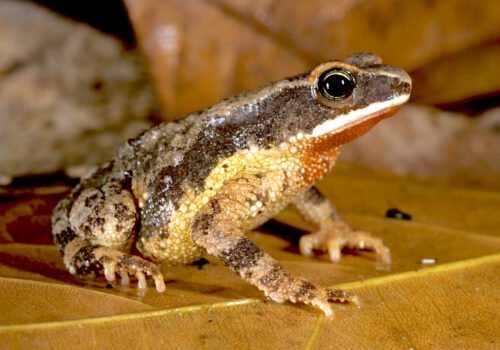
Adult individuals of Mertensophryne howelli are graceful in their modesty, measuring just about 30 to 45 millimeters in length, easily fitting on a human fingertip. Their appearance blends elegantly with their forest habitat: grey-brown or olive-colored skin marked with intricate spotting patterns that reflect the mosaic of leaf litter where they dwell.
A closer observation reveals their wart-covered skin, characteristic of true toads. But unlike their larger relatives, Howell’s Forest Toad retains an element of delicate charm—small, finely-textured warts pepper their body precisely enough to mimic scattered grains of earth or the texture of decomposing leaves. These warty protrusions enhance camouflage, making them nearly invisible as they sit motionless among foliage covered ground.
The eyes, large relative to their body size, reflect an adaptation towards their nocturnal life, attuned precisely to the whispers of shadows and faint lunar glow penetrating the forest canopy. Such adaptations are not merely aesthetic; they are essential survival traits evolved over millennia to shield them from predators and enable effective hunting of insects scurrying about the leaf litter.
Behavior and Life Cycle: Quiet Lives Enriched by Complexity#
Nocturnal by nature, Howell’s Forest Toad is most active during the gentle cover of darkness. As the sun dips behind dense mountain foliage, these tiny amphibians emerge from hiding spots to begin their nightly hunt. Their evenings are occupied with meticulous, patient stalking or ambushes of insects and other small invertebrates darting through decomposing organic matter.
Despite their diminutive stature, their method of hunting displays agility and precision. A swift flick of their adhesive, flexible tongues is capable of ensnaring prey faster than the human eye may register clearly. The silent forests become hunting grounds, as agile predators and evasive prey engage in an age-old dance perfected by countless generations.
The Rhythm of Life: Breeding and Reproduction#
When seasonal rains gently saturate forest habitats, it signals the onset of reproduction in Mertensophryne howelli. Male frogs fill the humid night air with subtle, melodious calls—songs of courtship woven into the tapestry of sound underpinning life in the forest. Female toads, guided by these calls, choose mates and subsequently lay eggs in carefully selected sites cultivating optimal conditions for developing embryos and eventual hatching tadpoles.
The eggs, laid in discreet clusters concealed beneath moist leaves or beside small puddles formed by rainwater, are incredibly sensitive to environmental changes. Tadpoles hatch and complete their metamorphosis in small pockets of water or damp spaces, quickly transitioning into miniature versions of adults—displaying remarkable adaptability for life in an ever-changing microhabitat.
Ecological Role: Integral Threads in Forest Fabric#
Though often overlooked, Mertensophryne howelli plays a fundamental role in maintaining ecological balance. As predators, these toads regulate insect populations, ensuring the health and stability of forest ecosystems. Conversely, servicing the role of prey, they provide sustenance for mammals, reptiles, and larger insectivores, becoming a crucial component in the food web.
Their presence or absence acts as a valuable bioindicator, warning observers about environmental quality and ecological conditions. Declines in their populations may signify unseen threats such as pollution, habitat disruption, or climate variability—early signs prompting conservationists to intervene.
Threats and Conservation Status: Guarding Nature’s Hidden Treasure#
Currently, the International Union for Conservation of Nature categorizes the Howell’s Forest Toad as Near Threatened—a status urgently signaling the necessity for preventive conservation efforts. Their populations dwindle primarily due to habitat loss from deforestation, agriculture expansion, human settlements intruding into forest ecosystems, and climate-driven habitat changes altering patterns of rainfall and moisture.
Research-driven conservation local initiatives strive to foster awareness among local communities and establish protective measures for their delicate and essential habitats. Conservationists advocate for sustainable land-use strategies, emphasizing the preservation of crucial habitats that support these diminutive ecosystem architects.
Cultural and Scientific Significance: Frogs as Natural Messengers#
Indigenous communities within Tanzania often recognize forest amphibians as integral aspects of ecosystems, symbols of rain, and indicators of ecological harmony. While Howell’s Forest Toad maintains a quieter profile than more prominent species celebrated in local folklore, they contribute similarly as indicators of forest vitality.
Scientifically, amphibians like Mertensophryne howelli are sentinel species, alerting us to nuanced environmental disturbances invisible to human observation. Research exploring the species’ specialized adaptations, ecological roles, and vulnerability to changing climates enriches our understanding of broader global ecosystems.
Conclusion: Recognizing Our Shared Responsibility#
In learning about Howell’s Forest Toad, we peel back layers of nature’s complexity and intimacy, underlining the intricate connections binding our planet. The quiet presence of creatures like Mertensophryne howelli significantly influences forest health, ecological function, and biodiversity.
By understanding, appreciating, and advocating for even the smallest of nature’s inhabitants, we embrace our collective stewardship responsibility toward conserving our planet. Let us treasure Howell’s Forest Toad as we commit to preserving the interconnected fabric of our world—lest their quiet songs fall silent forever.