- Melanophryniscus spectabilis: The Vibrant Jewel of South America's Highlands
- Taxonomy and Classification
- Natural Habitat: Living Among the Clouds
- Physical Characteristics: A Jewel-like Appearance
- Behavior and Life Cycle
- Ecological Role: Small Frog, Major Impact
- Threats and Conservation Status
- Cultural and Scientific Significance
- Conclusion: Protecting a Tiny Ambassador of Biodiversity
Melanophryniscus spectabilis: The Vibrant Jewel of South America’s Highlands#
In the lush, windswept grasslands and mist-shrouded highlands of southern Brazil, a remarkable tiny amphibian shines like a precious gemstone hidden among moss-clad slopes and sparkling streams. The Melanophryniscus spectabilis, aptly named for its spectacular coloration and striking appearance, thrives quietly amid the plants and grasses festooned with morning dew. Often referred to as the “Splendid Red-belly Toad,” this fascinating species captures the hearts of amphibian enthusiasts, conservationists, and ecologists alike. Measuring only a few centimeters in length, Melanophryniscus spectabilis punches far above its weight in ecological and aesthetic significance.
This diminutive yet brightly colored creature stands as a testament to the beauty and ecological complexity of the South American highlands. However, despite its vibrant appearance, much of its intriguing biology and behavior remain unknown or under-studied by science, creating an irresistible appeal for researchers and wildlife watchers alike.
Taxonomy and Classification#
Melanophryniscus spectabilis belongs to the family Bufonidae, a family of amphibians more widely known as “true toads.” However, unlike their typical toad kin, members of the genus Melanophryniscus distinguish themselves through their luminous coloration and specialized adaptations.
First described scientifically by Caramaschi & Cruz in 2002, Melanophryniscus spectabilis is part of a genus recognized for its brightly colored, aposematic patterns that warn potential predators of their toxic skin secretions. Closely related species within the genus, such as Melanophryniscus admirabilis and Melanophryniscus cambaraensis, also share these captivating visual features, though each exhibits its unique combination of hues and patterns.
Natural Habitat: Living Among the Clouds#
The Melanophryniscus spectabilis is endemic exclusively to Brazil’s southern regions, particularly the state of Santa Catarina, thriving in mountainous areas at higher altitudes of around 800–1600 meters. These serene landscapes host a mosaic of upland habitats, including rocky outcrops, montane grasslands, and temperate shrublands punctuated by crystalline streams and marshy wetlands.
Habitat Preferences and Microhabitats#
The species favors humid microhabitats, often sheltering among moss patches, grass clumps, and shallow pools that form after the seasonal rains. Gentle freshwater trickles, rocky slopes, and moist leaf litter provide reliable sanctuaries for shelter, feeding, breeding, and tadpole development.
Amid these elevated habitats, climatic conditions oscillate between extremes: prolonged rainy seasons and dry periods alternating annually. Melanophryniscus spectabilis has thus evolved to excel in habitats bound by seasonal patterns, making it a noteworthy example of adaptation to Brazil’s mountainous subtropical climates.
Physical Characteristics: A Jewel-like Appearance#
Melanophryniscus spectabilis commands attention through its vivid coloration. Adults commonly measure only about 20–26mm in length, placing them among the smallest of toads. Their rounded bodies and limbs are relatively petite, built perfectly for life within the intimate spaces of moss cushions and vegetation mats.
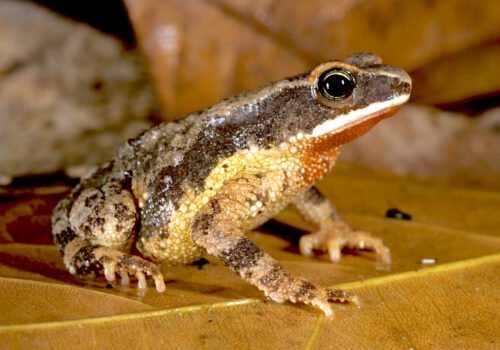
The species’ most dazzling feature is its unmistakably bright ventral surface, painted richly with vibrant shades ranging from crimson reds and brilliant oranges, sometimes marked by dark, irregular blotches. The contrast with their dark dorsum—usually a subtle blackish or deep brown tone—is stark, creating an arresting visual display meant as a clear message to predators.
Aposematism and Defense Mechanisms#
Melanophryniscus spectabilis possesses toxic skin secretions containing alkaloids, effective deterrents against predators. The vibrant belly coloration signals toxicity, a defensive strategy known as aposematism. This alert mechanism teaches predators to avoid the striking toad, ultimately ensuring its survival.
Behavior and Life Cycle#
Despite its diminutive size, Melanophryniscus spectabilis is active and resilient. This species demonstrates considerable agility, hopping gracefully through its rugged environment in search of food and mates. Primarily diurnal, their regular activity peaks correspond with seasonal rainfall patterns.
Feeding Habits and Diet#
As opportunistic feeders, these tiny toads consume small invertebrates, notably ants, mites, springtails, and beetles. Their selective insect diet contributes significantly to the alkaloid toxins accumulated in their skin, making their diet intricately linked with their defense mechanisms.
Breeding Behavior and Reproduction#
Melanophryniscus spectabilis exhibits reproductive behaviors closely synchronized with rains and wet periods. Males gather in shallow pools or moist depressions, emitting faint, bird-like calls to attract females. Upon successful pairing, females deposit eggs in clear, shallow pools. Tadpoles, well-adapted to ephemeral pools, mature rapidly, metamorphosing prior to the drying of their tiny aquatic worlds—a remarkable adaptation further highlighting their resilience amid challenging mountainous conditions.
Ecological Role: Small Frog, Major Impact#
Small yet influential, Melanophryniscus spectabilis holds crucial roles within the local ecosystem dynamics. Serving as both predator and prey, this little amphibian occupies critical ecological niches, contributing to arthropod population regulation and energy flow.
Its high sensitivity to habitat quality renders it an excellent bioindicator species. Population fluctuations or declines often signal environmental distress, providing ecologists indispensable warnings on ecosystem health and stability.
Threats and Conservation Status#
Despite their resilient nature, Melanophryniscus spectabilis faces significant threats, pushing their conservation into critical focus. They are currently listed as Vulnerable by the International Union for Conservation of Nature (IUCN), primarily due to habitat degradation, fragmentation, and loss brought forth by expanding agricultural practices, invasive plant species domination, and uncontrolled tourism activities.
Climate Change Exacerbating Risks#
Increasingly unpredictable seasonal rainfall patterns and droughts due to climate change present critical threats. Since the toads rely heavily on seasonal wet-dry cycles, any alteration jeopardizes their delicate breeding cycles, potentially leading to drastic population declines if these habitats vanish or dry prematurely.
Current Conservation Actions#
Thankfully, conservationists and scientific researchers actively advocate for habitat management and restoration efforts specifically aimed at safeguarding Melanophryniscus spectabilis populations. These initiatives involve habitat rehabilitation, control of invasive plant species, engagement with local communities to promote sustainable farming practices, conservation education, and scientific monitoring to gauge the effectiveness of protective measures.
Cultural and Scientific Significance#
Locally, Melanophryniscus spectabilis represents more than merely ecological importance. Communities residing throughout its native ranges cherish it as a symbol of their heritage landscapes, marking the species as an iconic element of southern Brazil’s biodiversity richness.
Scientifically, the species represents potential avenues of exploration—studying their alkaloids could open doors to the discovery of medicinal compounds. Furthermore, amphibians like Melanophryniscus spectabilis illuminate broader ecological trends and ecosystem services, making them important ambassadors for biodiversity awareness.
Conclusion: Protecting a Tiny Ambassador of Biodiversity#
The vibrant spectacle embodied by Melanophryniscus spectabilis evidences nature’s astonishing diversity and adaptability. As tiny inhabitants of the montane ecosystems of southern Brazil, they fulfill vital ecological roles, bear witness to environmental changes, and reflect cultural ties for local communities.
This delicate balance hinges on proactive conservation efforts. By understanding, valuing, and preserving species like Melanophryniscus spectabilis, we not only safeguard nature’s beauty but also the essential ecological relationships and biodiversity upon which we, too, depend.
We invite you, dear reader, to become advocates for these captivating creatures. Engage yourself in ecosystem stewardship, support local conservation efforts, and continue to learn about the remarkable wildlife inhabiting our shared planet. Together, we can cherish and protect tiny yet wondrous wonders like Melanophryniscus spectabilis, ensuring their survival and prevalence for generations to come.