Exploring the Enigmatic San Martin Redbelly Toad (Melanophryniscus sanmartini)#
Beneath the lush canopy of northern Argentina’s subtropical forests thrives a fascinating amphibian, small in stature but immense in biological importance—the San Martin Redbelly Toad (Melanophryniscus sanmartini). A jewel-like amphibian known not only for its compelling coloration but also its intriguing behaviors and ecological significance, this tiny toad occupies a unique and precious niche within our extraordinary natural world.
The San Martin Redbelly Toad is a testament to nature’s artistry, a living emblem symbolizing the fragile harmony of specialized habitats and biodiversity. While it may not have garnered the visibility of more charismatic fauna, this vibrant little creature has become a subject of increasing scientific fascination—and unfortunately, growing conservation concern.
What makes this amphibian so distinctive, and why is it crucial to protect its fragile habitat? Join us on an immersive exploration into the life, ecological role, and future conservation of Melanophryniscus sanmartini.
Taxonomy and Classification#
To understand the ecological complexities of this fascinating amphibian, let’s first position it scientifically. The San Martin Redbelly Toad belongs to the family Bufonidae, better known as True Toads. Within this family, it inhabits the intriguing genus Melanophryniscus—a group of colorful, often strikingly patterned anurans notably characterized by their small size and the presence of alkaloid-based toxins in their skin.
The San Martin Redbelly Toad was officially described relatively recently in herpetological history, highlighting the vast unknown biodiversity still awaiting discovery in Argentina’s ecosystems. Closely linked with other tiny toads of the genus, it has distinguishable morphological and genetic traits authenticating its classification as an individual species. The nuances in these species often reside not just in morphology but in unique behavioral or ecological characteristics as well.
Natural Habitat#
Melanophryniscus sanmartini is famously selective, restricting itself to specific pockets of moist subtropical forests in northern Argentina, particularly in the regions around Misiones and Corrientes Provinces. These forests, characterized by subtropical humidity, robust canopy cover, and abundant leaf litter carpeting their forest floor, provide the ideal refuge and breeding grounds for the species.
Within this vibrant landscape, the San Martin Redbelly Toad favors habitats near slow-moving streams, humidity-rich shaded areas, and pockets of temporary ponds created by seasonal rains. Indeed, the species has evolved to specialize in these ephemeral aquatic environments, seizing the fleeting opportunities provided by seasonal shifts—an adaptive strategy emblematically reflecting the dynamic interplay between organism and ecosystem.
During humid periods, one can sometimes witness small gatherings of these vividly colored toads among the scattered foliage, their presence betrayed principally by careful observers who recognize their cryptic movements and faint calls amidst the forest chorus.
Physical Characteristics#
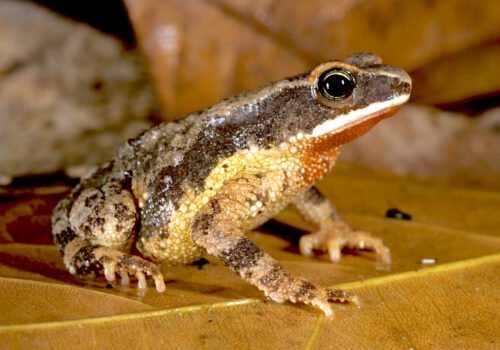
Arguably one of the most visually compelling features of Melanophryniscus sanmartini is its striking coloration pattern, imbuing it with both visual charm and ecological significance. Measuring a modest 2 to 3 centimeters in length, this small toad displays a dramatic contrast between its dorsal (upper) and ventral (lower) coloration.
The dorsal surface boasts a dark, almost black color punctuated by small vivid speckles or irregular patterns of bright reds, oranges, and yellows. This dazzling chromatic display continues dramatically beneath the animal, where a bold and fiery red belly marks its most recognizable trait—earning its common moniker, the San Martin Redbelly Toad.
Remarkably, these resplendent colors are not merely decorative; they signal a critical adaptive purpose. The vibrant pigmentation serves as an effective aposematic coloration—a clear warning that predators quickly learn to associate with danger or distaste. Alkaloid toxins secreted from specialized skin glands offer an effective defensive mechanism against predators, rendering these small amphibians remarkably secure despite their conspicuous appearance.
Behavior and Life Cycle#
Feeding and Predation Tactics#
By day, these toads are secretive and challenging to spot, typically hiding beneath logs, leaf litter, or within crevices in moist soils. But as dusk approaches, their behavior changes dramatically, becoming more active predators in their forested environment. Benefiting from excellent vision and a keen sense of scent, they hunt their primary prey: small insects and other invertebrates.
The San Martin Redbelly Toad patiently waits, camouflaged by shadows, using rapid tongue strikes to capture hapless prey that crosses its path. Its hunting techniques underscore its meticulous adaptation to the subtropical landscape, dependent upon precise predatory timing to heel the delicate balance of prey-predator relationships within the forest micro-ecosystems.
Mating and Reproduction#
When heavy rains return, giving birth to seasonal pools, these amphibians awake dramatically into their breeding season, a brief window for reproduction. Males congregate near ephemeral bodies of water, issuing muted, gentle calls with surprisingly melodious quality—characteristically rich and resonant for such diminutive creature—to attract females.
Females lay small clusters of eggs carefully anchored to submerged vegetation. The cluster, delicately placed by meticulous maternal positioning, ensures optimal security as eggs mature into water-dependent tadpoles over several weeks. Rapid growth facilitated by nutrient-rich seasonal ponds allows these tadpoles to metamorphose within a limited, yet synchronously perfected, lifespan dictated by nature’s seasonal timetable. Emerging juveniles then migrate back to terrestrial habitats, continuing a cycle that has persisted unchanged for millennia.
Ecological Role#
This small yet vibrant toad influences its local ecosystem profoundly. Its voracious appetite for insects helps regulate insect populations, maintaining ecological stability and minimizing potential pest outbreaks. Equally, its presence provides sustenance for carefully specialized predators immune or resistant to its toxins, such as certain birds, snakes, and larger amphibians—accentuating its integral role in the intricate web of subtropical life.
Furthermore, the amphibian’s sensitivity to environmental changes positions it as a vital ecological indicator species for scientists. Changes in population health or distribution can alert researchers early on to developing issues such as contamination, climate disruptions, or habitat degradation, providing vital data necessary for conservation interventions.
Threats and Conservation Status#
Unfortunately, the very specificity of Melanophryniscus sanmartini‘s habitat has rendered the species increasingly vulnerable to threats posed by human activities and environmental change. Deforestation for agriculture, expanding livestock grazing, and human settlement encroachment profoundly impact their restricted ranges, fragmenting habitats into ever-smaller, less viable pockets of refuge.
Additionally, changes in rainfall patterns caused by shifting climate conditions severely threaten their seasonal reproductive cycles. Subtle yet cumulative factors—pollution, chemical pesticides, or diseases like Chytridiomycosis—compound these threats, pressuring the species towards precarious population declines.
This has led the IUCN (International Union for Conservation of Nature) to classify the San Martin Redbelly Toad as “Vulnerable,” highlighting the urgency with which coordinated conservation efforts are required to safeguard this charismatic yet vulnerable amphibian.
Cultural and Scientific Significance#
Although somewhat overlooked in popular culture, the San Martin Redbelly Toad has started garnering attention within scientific communities due to its remarkable aposematic colorations and potent toxins, opening doors towards medical and biochemical research. Amphibians of the genus Melanophryniscus are known to produce unique alkaloids that intrigue scientists looking into novel therapeutic uses, from developing new analgesics to better understanding pain signaling mechanisms.
Within local indigenous and cultural narratives, the toad represents resilience—small yet powerful, signifying nature’s complexity and strength. Thus, in achieving local community support for conservation, leveraging this symbolic significance might form part of regional conservation strategies.
Conclusion and Our Call to Action#
The San Martin Redbelly Toad—Melanophryniscus sanmartini—is a captivating testament to biodiversity’s delicate yet imaginative beauty. A single glance at its mesmerizing colors inspires wonder, yet its very existence speaks deeper truths about habitat interconnectedness, ecological fragility, and our collective responsibility toward nature’s conservation.
Understanding this tiny toad’s biology, behaviors, and vulnerabilities strengthens our resolve as nature enthusiasts, students, and conservation advocates to protect its habitat and ensure its place within Argentina’s natural heritage for generations to come.
We invite you to support conservation initiatives, share this narrative with peers, and continue exploring nature’s remarkable intricacies—remembering always that the smallest creatures often carry outsized roles in maintaining ecological harmony.