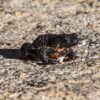
Exploring the Enigmatic Melanophryniscus nigricans: Uruguay’s Unique Dark-Bellied Toad#
Introduction#
Hidden amidst the dense grasses and humid pampas landscapes of Uruguay and southern Brazil, an intriguing little amphibian thrives unseen by most eyes—the Dark-Bellied Toad, scientifically known as Melanophryniscus nigricans. Distinguished by its beautifully contrasted coloration and unique adaptations, this small but remarkable amphibian represents a captivating chapter in the complex narrative of South American biodiversity.
At first glance, the Dark-Bellied Toad may appear unassuming, yet a closer inspection reveals intriguing biological secrets. Among the vibrant mosaic of frogs and toads inhabiting this region, M. nigricans stands apart—not only due to its striking black and red markings that signal danger to predators, but also as a sentinel of environmental health, capable of telling us critical stories about the well-being of its delicate habitats.
Join us as we immerse ourselves in the fascinating world of Melanophryniscus nigricans, exploring its hidden life, mysterious behaviors, and current challenges in a rapidly changing landscape. This journey will deepen our appreciation of this tiny toad’s remarkable significance in both natural ecosystems and human cultural spheres.
Taxonomy and Classification#
The diminutive Dark-Bellied Toad belongs to the Bufonidae, a diverse family better known as “true toads.” Within this extensive family, the genus Melanophryniscus stands as a small group of Neotropical toads well-known among scientists for their fascinating chemical defenses and vibrant coloration.
The genus name Melanophryniscus itself draws from Greek, where “melanos” alludes to their characteristically dark pigmentation and “phrynos” relates to ‘toad-like’ animals. The species epithet “nigricans” also points to the animal’s predominantly black coloration—a trait beautifully contrasted by localized vibrant red or orange markings.
Closely related species, such as Melanophryniscus stelzneri and Melanophryniscus montevidensis, share similar habitats and characteristics, but each species possesses unique patterns and ecological adaptations that distinguish its role within their respective environments.
Natural Habitat#
Melanophryniscus nigricans occupies a relatively limited geographical range, primarily spanning regions within Uruguay’s grassy pampas and southern Brazil’s adjacent wetlands. This species favors moist grassland habitats—particularly areas with seasonal flooded terrains and shallow pools. Such wetlands offer ideal breeding grounds, with temporary pools providing safe places for eggs and tadpoles while limiting the presence of certain predators, such as fish, that prefer permanent water.
The pampas ecosystems where this amphibian lives are characterized by rich, fertile soil supporting a complex network of grasses, sedges, and herbaceous plants. These habitats frequently transform, alternating between periods of flooding and drought, shaping the life cycle and behaviors of its amphibian denizens. Here, amidst tall, whispering grasses, the Dark-Bellied Toad skillfully hides from its predators while lying in patient wait for insects and other invertebrates passing nearby.
However, M. nigricans‘ preferences render it vulnerable to habitat alteration such as agricultural conversion or infrastructural development, making habitat conservation foundational to its long-term survival.
Physical Characteristics#
With its modest size, measuring roughly 20 – 35 millimeters in length, Melanophryniscus nigricans might easily be overlooked without thorough inspection. Yet despite its small stature, it is among the most visually arresting amphibians in its region.
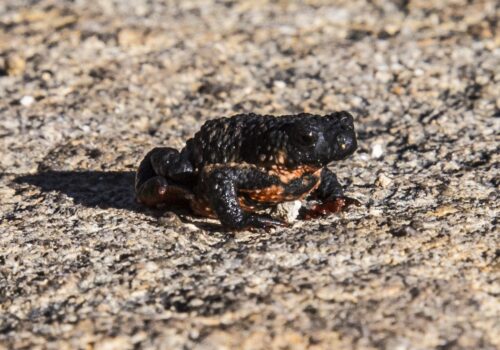
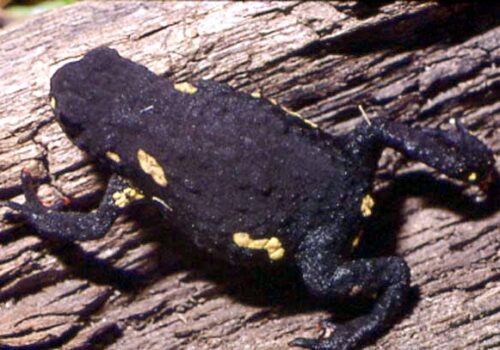
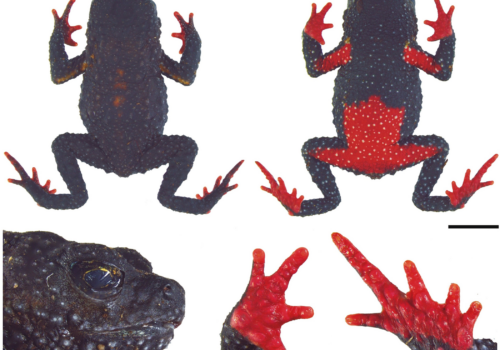
The dorsal surface of this amphibian predominantly features black or very dark brown coloration, punctuated sporadically by vivid splashes of reddish-orange pigment. Such bright hues contrast vividly with the surrounding dark pigmentation, a classic aposematic display that warns predators about the toxic compounds secreted through its skin glands. These dynamic colorations not only serve as visual warnings but also subtly blend into the complex shadow-and-vegetation mosaic of its grassy home.
Its skin texture, remarkable upon close inspection, feels granular to the touch, covered in tiny glands responsible for producing toxins that defend it against predators and microbial infections. The underside, as the common name indicates, is typically a darker hue, providing additional camouflage and protection.
The Dark-Bellied Toad’s specialized limbs are adapted for living primarily on land, bearing short but robust hind legs essential for its characteristic short, hopping movements through dense grasses.
Behavior and Life Cycle#
Feeding Habits and Predatory Strategies#
The Dark-Bellied Toad is an efficient insectivore, feeding primarily on tiny, abundant preys such as ants, termites, small beetles, and other ground-dwelling insects. Its life at ground level, under cover of vegetation, offers a rich and constant supply of small invertebrates. Patiently existing amid grumpy leaf litter and grass stems, the toad employs a sit-and-wait strategy: still and silent, eyes alert, tongue ready to snap insects that approach too near.
Breeding and Reproduction#
Breeding typically aligns closely to the seasonal rains. With moisture levels rising and temporary water pools appearing, each rainy season prompts an orchestrated ascent of calls reverberating across the grasslands, with males competing vocally to attract receptive females. Their mating calls, though quiet compared to many amphibians, carry across small patches of grassland, creating a subtle, harmonious background noise, an auditory signature of their limited, ephemeral wetland habitats.
After mating, females lay small clutches of eggs in shallow, temporary pools. The eggs and developing tadpoles are translucent, mirroring the clear waters they inhabit, thus increasing their chances of survival in a world dense with potential threats. Rapid transformation is the key to survival here; from eggs to tadpoles, and from tadpoles to fully metamorphosed froglets, young toads hurry through their aquatic phase as the rains recede and ponds dry, establishing themselves on the grassy land once again.
Ecological Role#
Melanophryniscus nigricans plays an integral ecological role, shaping and balancing insect populations in ecosystems it inhabits. As dedicated insectivores, these small amphibians regulate populations of ants, termites, and other insects, indirectly influencing plant health and soil structure.
Additionally, their abundant potential predators—ranging from birds and snakes to mammals—rely on amphibians such as this to sustain their diets. Despite its defensive toxins, adapted predators play their part in the age-old evolutionary arms race. Consequently, vibrant populations of Dark-Bellied Toads are clear signs of healthy ecosystems, making them ideal indicators of environmental quality and conservation effectiveness in regional habitats.
Threats and Conservation Status#
Despite its ingenious adaptations, this charming amphibian confronts substantial threats. In recent times, habitat destruction remains the foremost danger due to agricultural practices, infrastructure development, and urban expansion across southern South America. Conversion of natural pampas grasslands into large-scale monocultures reduces the breeding success and survivability of populations. In addition, pesticides used extensively in agriculture pose another significant threat by contaminating aquatic breeding habitats, triggering declines or even local extinctions.
Currently, the International Union for Conservation of Nature (IUCN) assesses M. nigricans as Near Threatened, signaling that although not yet critically endangered, proactive conservation efforts are urgently needed to reverse declines and prevent further deterioration of its fragile habitats.
Cultural and Scientific Significance#
Interestingly, toad species within the genus Melanophryniscus have a notable reputation within indigenous cultures, often associated with vivid symbolism involving transformation and adaptability. Additionally, researchers increasingly value these amphibians for their significance in biotechnology, particularly exploring the complex chemicals produced by their toxin glands, some potentially harboring pharmaceutical applications and medical properties.
Conclusion#
Melanophryniscus nigricans, Uruguay’s distinctly colored, secretive amphibian, exemplifies the subtle yet profound connectivity within natural ecosystems. Understanding and preserving this charismatic amphibian combines ecological importance, bioindicator value, and the potential for novel scientific discoveries.
We invite you to deepen your appreciation of such often-overlooked species and actively support conservation initiatives protecting their unique habitats, thereby safeguarding these fascinating little toads and the rich biodiversity they represent for generations to come.