- Exploring Melanophryniscus krauczuki: The Enigmatic Jewel of South America's Amphibian World
- Taxonomy and Classification: Unraveling the Toad's Identity
- The Natural Habitat: A Patchwork Paradise
- Physical Characteristics: Unveiling Nature's Artistic Masterpiece
- Behavior and Life Cycle: A Symphony in Motion
- Ecological Role: Tiny Amphibians with Tremendous Importance
- Threats and Conservation Status: On the Brink yet Fighting Back
- Cultural and Scientific Significance: From Folklore to Medical Significance
- Conclusion: Preserving the Subtle Wonders Around Us
Exploring Melanophryniscus krauczuki: The Enigmatic Jewel of South America’s Amphibian World#
In pockets of South America’s lush subtropical grasslands, wetlands, and gently waving pampas, a creature small enough to perch softly upon a thumb reveals itself in dazzling patterns. Its skin, a mosaic of striking yellow, deep black, and bold splashes of scarlet and orange, belies a powerful secret—it’s packed with some of nature’s most potent defenses. Meet Melanophryniscus krauczuki, a captivating amphibian species, often hidden in plain sight, whose life unfolds quietly yet brilliantly amid tranquil wetlands of Argentina’s Misiones and Corrientes provinces.
Often overlooked in favor of flashier, more renowned amphibians, Melanophryniscus krauczuki exemplifies the astonishing diversity within South America’s landscapes, reminding us that beauty, intrigue, and ecological value come in creatures of all sizes. Hardly larger than a grape, this tiny toad epitomizes resilience and uniqueness as it navigates life in a quickly changing world.
Taxonomy and Classification: Unraveling the Toad’s Identity#
The Melanophryniscus krauczuki belongs to the family Bufonidae, commonly known as the true toads. Within this family sits the enigmatic genus Melanophryniscus, known colloquially as the South American red-bellied toads. Named in honor of the noted Argentinian herpetologist Ernesto Krauczuk, who first studied and described the species extensively, the species carries his legacy quietly yet profoundly.
Closely related species within its genus share the characteristic bright warning coloration—signifying toxicity and deterring predators—a biological strategy collectively known as aposematic signaling. Yet each species, including the krauczuki, reveals distinct variations unique enough to aid conservationists and taxonomists in their ongoing efforts to categorize, identify, and preserve these remarkable amphibians.
The Natural Habitat: A Patchwork Paradise#
The story of Melanophryniscus krauczuki unfolds in Argentina’s northeastern provinces, primarily Misiones and Corrientes, where vast wetlands, gently rolling pampas, and subtropical grasslands come together, creating an ecological tapestry uniquely suited to the toad’s lifestyle. These thriving wetlands form a patchwork of seasonally inundated marshes, grassy fields, and shallow lagoons—ideal terrains for the species to breed, feed, and survive.
The mosaic nature of their habitat allows them to blend seamlessly, amid brightly colored flowers and leaf litter, flourishing in pockets of moist, open environments punctuated by seasonal fluctuations. Their dependence on shallow, ephemeral water bodies—puddles and temporary ponds—makes these areas particularly crucial for breeding, altering their seasonal behaviors accordingly and highlighting the fragility of their existence, tied intimately to water cycles and rainfall.
An Ecosystem Harmony: Why Its Habitat Is Essential#
Adapted brilliantly to survive wet-dry seasonal cycles, the krauczuki has evolved to utilize transient water sources expertly. Their short breeding window aligns closely with the region’s rainy periods, providing moisture-rich conditions conducive to egg-laying and tadpole development. Meanwhile, dry conditions shape the adult frogs’ terrestrial lifestyle, driving them to seek refuge under damp vegetation, fallen leaves, and rich humus-covered soils.
Physical Characteristics: Unveiling Nature’s Artistic Masterpiece#
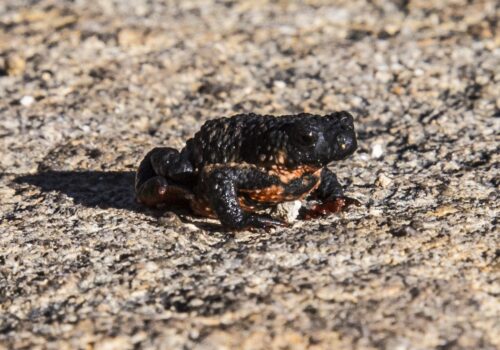
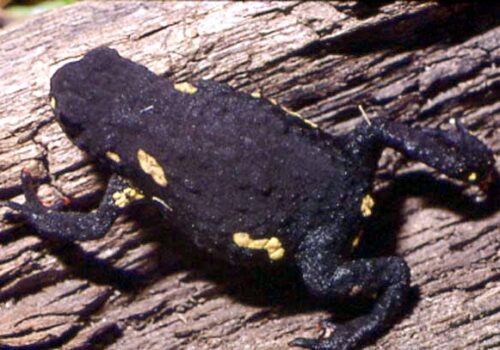
If ever there were a master painter at work in nature’s workshop, Melanophryniscus krauczuki would be its masterpiece. Adult specimens rarely exceed 30 mm in body length—approximately the size of a grape seed—but their compact bodies host vibrant hues and distinct contrast solutions. Bright patches of intense reds and yellows juxtapose starkly against jet-black backgrounds, a clear visual signal broadcasting their potent chemical defense systems.
Unlike many rainforest frogs, this toad’s skin texture possesses a rugged roughness speckled with tiny bumps. Beneath their bellies, fiercely saturated orange to fiery red colors dominate, enhancing the visual warnings to predators. These colorations serve as unmistakable signals—a cautionary palette advertising the toxins developed through their specialized diet. Its colors provide protection, predator deterrence, and perhaps even courtship attraction in a world where visual cues speak louder than any call.
Behavior and Life Cycle: A Symphony in Motion#
As dusk descends upon Argentina’s wetlands and pampas, subtle movements stir amidst vegetation. Melanophryniscus krauczuki emerges, drawn out by moisture and cooler temperatures, seeking prey among leaf litter, fallen vegetation, and shallow pools. Its diet primarily comprises small invertebrates, including ants, beetles, mites, and tiny spiders. This prey selection forms a critical layer in their chemical defensive strategy, as consuming certain insects provides the toxic alkaloids that fortify their skin defenses.
A Delicate Dance: The Breeding Season#
With the return of rains, and following seasonal cycles intricately woven with moisture’s rhythm, it’s mating season. Males emit soft yet distinct advertisement calls, a short melody punctuating humid dusk air, resonating faintly across shallow pools to attract receptive females. Successful encounters culminate in ephemeral breeding events lasting mere days or weeks.
The female krauczuki deposits their string-like masses of tiny black eggs directly into moist grass or leaves near shallow pools. Upon contact with water during rain showers, they unfurl, and tadpoles promptly hatch. The youngsters must rapidly mature, transitioning from gilled aquatic larvae into terrestrial juveniles over fleeting weeks—a testament to evolution’s effectiveness amid seasonal unpredictability. Each tadpole entering life is a miniature emblem of adaptation, resilience, and survival.
Ecological Role: Tiny Amphibians with Tremendous Importance#
Despite their diminutive size, Melanophryniscus krauczuki plays outsized ecological roles. It regulates insect populations, thus shaping local microhabitats. By consuming specific arthropods, these tiny toads demonstrate how predator-prey relationships serve to balance ecological networks, keeping elements of their wetland and grassland communities in equilibrium.
Moreover, being a prey animal itself, it contributes significantly to local food webs, providing nourishment to reptiles, birds, small mammals, and even larger insects tolerant to toxins. Furthermore, its sensitivity to habitat changes and pollution renders the species an ecological sentinel, indicating the health, integrity, and biodiversity of subtropical and wetland ecosystems.
Threats and Conservation Status: On the Brink yet Fighting Back#
Melanophryniscus krauczuki faces challenges considerably heightened in recent decades, primarily anchored by habitat loss and environmental degradation. Agricultural expansion, chemical pesticides from farming, rapid urban encroachment, and critically, altered rainfall patterns due to climate change—all coalesce, threatening its survival.
As per the International Union for Conservation of Nature (IUCN), the species presently holds a classification of “Vulnerable,” signaling the necessity for proactive conservation actions. Currently, scientific communities, conservation organizations, and regional wildlife authorities are collaborating on habitat restoration projects, wetland protection initiatives, and public education outreach, aiming to secure a thriving future for this tiny ambassador of ecological richness.
Cultural and Scientific Significance: From Folklore to Medical Significance#
Indigenous communities living adjacent to subtropical wetlands have historically admired brightly-hued amphibians as symbols of environmental purity and health indicators. Although direct folklore specific to Melanophryniscus krauczuki remains scant, amphibians of related genera historically find their way into cultural symbolism, cautionary tales, or lore as indicators of weather changes, purity of water, and balance in nature.
Scientifically, the skin toxins of these toads are subjects of ongoing biochemical research, as understanding alkaloid compounds has the potential to contribute significantly to medical advancements in pharmaceuticals, yielding analgesics, antibiotics, or topical antiseptics derived from natural defenses honed by evolution.
Conclusion: Preserving the Subtle Wonders Around Us#
The tale of Melanophryniscus krauczuki reminds us that the world’s biodiversity is as delicate as it is beautiful. This tiny South American toad symbolizes resilience, ecological interconnectedness, and nature’s awe-inspiring solutions to survival. By appreciating and advocating for the conservation of subtle natural wonders like krauczuki, we contribute meaningfully to safeguarding biodiversity and maintaining ecological integrity for generations to come.
Let us carry forward this awareness, inspired to learn more, support local and global amphibian conservation endeavors, and protect the rich tapestry of life that these unique species help illuminate.