- Introduction: Meet the Java Tree Toad - Leptophryne javanica
- Taxonomy and Classification
- Natural Habitat: Life Hidden in Java’s Misty Rainforests
- Physical Characteristics: Blend Into the Shadows
- Behavior and Life Cycle: Harmonies of the Night
- Ecological Role: Guardians of Forest Health
- Threats and Conservation Status: Shadows of Decline
- Cultural and Scientific Significance: Treasures Beyond Appearance
- Conclusion: Unveiling the Mysteries, Ensuring the Future
Introduction: Meet the Java Tree Toad – Leptophryne javanica#
Deep within the misty rainforests of Java, amidst a tapestry of leaves slick with moisture and moss-covered stones, hides a remarkably elusive creature—a small amphibian known scientifically as Leptophryne javanica, commonly called the Java Tree Toad. Though its modest size and cryptic coloration help it blend seamlessly into its environment, this amphibian plays a richly meaningful ecological role that transcends its humble appearance.
The Java Tree Toad is not just another rainforest inhabitant; it represents one of nature’s subtle marvels—an expert of camouflage, a symphony orchestrator of nocturnal choruses, and a living barometer signaling the health of its lush Javanese habitat. Yet, despite these fascinating traits, the Java Tree Toad remains largely unknown outside specialist circles and avid naturalist groups. This intriguing obscurity makes understanding—and conserving—this amphibian all the more pertinent.
Taxonomy and Classification#
The journey into understanding any species begins with its place in the tree of life. Leptophryne javanica belongs to the Bufonidae family—commonly known as true toads. Within this family, the genus Leptophryne consists of a relatively small group distinguished by their specialized adaptations to dense rainforest habitats. Closely related species include Leptophryne borbonica, yet the Javanica species stands distinctly separate, having evolved specialized traits unique to Java’s insular and richly diverse ecosystems.
Classifying the Java Tree Toad scientifically involves meticulous observation and genetic analysis. Scientists categorize it as follows:
- Kingdom: Animalia
- Phylum: Chordata
- Class: Amphibia
- Order: Anura
- Family: Bufonidae
- Genus: Leptophryne
- Species: L. javanica
Natural Habitat: Life Hidden in Java’s Misty Rainforests#
Exploring the natural habitat of Leptophryne javanica takes us to the mystical montane forests and misty valleys across the volcanic slopes of Java, Indonesia. Tongues of mist frequently roll through these dense forests, carrying moisture essential for amphibian life. Here, beneath canopy layers thick and intertwined, the Java Tree Toad thrives in cool, humid environments near clear streams and waterfalls edged by mosses, lichens, and small ferns.
Unlike ground-dwelling toads of open fields, Java Tree Toads show marked preference for twilight darkness, damp leaf litter, and river-flattened stones that glisten under layers of moisture. The presence of pristine water sources creates an aquatic haven for their eggs and tadpoles, making their habitat sensitive to human disturbance. Interestingly, this species has adapted specifically to high-altitude, humid forest conditions—an ecological niche that speaks volumes of its evolutionary journey and adaptability.
Physical Characteristics: Blend Into the Shadows#
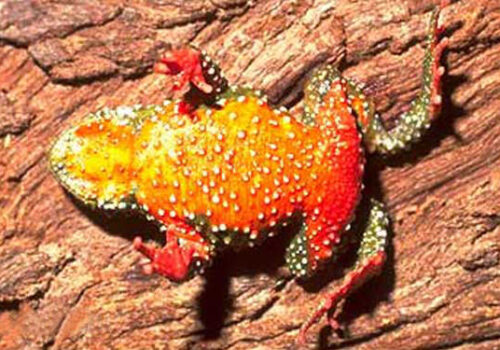
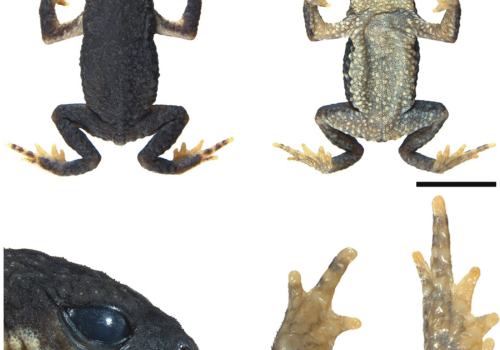
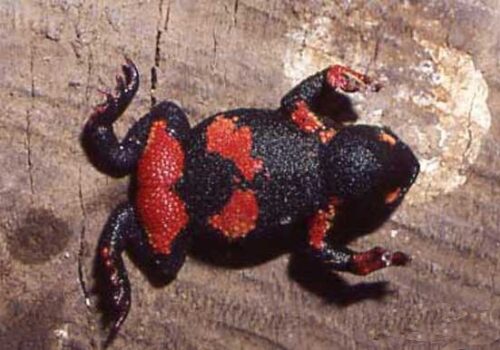
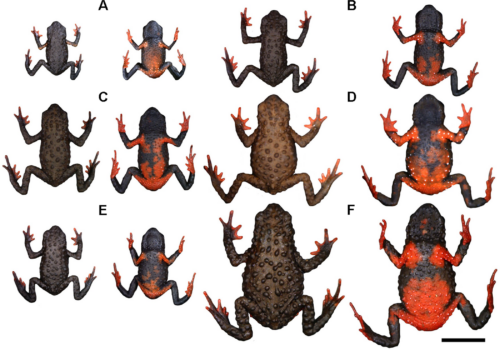
What may appear as a mere shadow on a damp leaf reveals itself upon closer inspection as the meticulously camouflaged outline of Leptophryne javanica. Adult Java Tree Toads typically measure between 30-45 mm in length, a size that makes discrete concealment achievable. Their skin, textured with fine granules, presents a palette of subtle, earth-tone hues—shades of olive-green, brown, and gray immaculately mimicking the decaying leaves and moss-covered barks.
Their bulging metallic eyes shimmer delicately in muted shades of bronze or golden amber, perfectly adapted to capture even faint beams of dappled forest light. Each toad’s coloration subtly differs, making individuals identifiable by experienced observers. This remarkable cryptic coloration functions as vital camouflage from the gaze of predators, providing life-saving moments of invisibility when danger looms.
Behavior and Life Cycle: Harmonies of the Night#
Nocturnal Habits and Diet#
Nocturnal by nature, these elusive toads spend daylight hours hidden among crevices and dense vegetation, emerging at dusk into cool night air humming with insect life. Their prey predominantly includes ants, termites, tiny beetles, and flies—small yet abundant delicacies attracted by forest moisture. Employing stealthy ambush tactics, the toads strike quickly with sticky, projectile tongues, efficiently feasting without significant energy expenditure.
Reproduction and Development#
Mating rituals in Leptophryne javanica involve captivating nocturnal choruses, initiated and persisted by males gathering near stream banks or shallow pools. Their gentle, vibrating calls resonate softly through the forest canopy, a delicate cacophony echoing gently off leaves. Females, enticed by these serenades, arrive to lay clusters of gelatinous eggs in slow-moving stream sections or shallow pools. Tadpole development is rapid and profoundly adapted to freshwater habitats, transforming through metamorphosis within weeks due to vulnerability to water disruptions or predation.
This swift developmental timeline ensures higher survival probabilities in their fluctuating habitats, making their life cycle both fascinating and precarious.
Ecological Role: Guardians of Forest Health#
Though small and reclusive, Leptophryne javanica plays a disproportionately significant ecological role. As insect predators within their ecosystem, these tiny beings actively regulate insect populations, maintaining delicate balances within forest food webs. Likewise, their own predation by birds, mammals, and larger reptiles fulfills a dual ecological function, serving as essential protein sources for local biodiversity.
Moreover, as sensitive bio-indicators, Java Tree Toad populations reflect intricate ecosystem health conditions. Their rapid susceptibility to habitat degradation, pollution, and climate variations make declines in their population an alarming early warning signal, implicating broader ecological threats that demand investigation and immediate action.
Threats and Conservation Status: Shadows of Decline#
Unfortunately, Java’s exquisite forests—and consequently its amphibian residents—face relentless threats from deforestation, agricultural expansion, and human infrastructure projects. Habitat fragmentation isolates populations, reducing genetic exchange necessary for species vitality. Pollution from agricultural runoff also disturbs fragile aquatic nurseries where their tadpoles develop, contributing profoundly to their decline.
Currently, Leptophryne javanica is categorized as ‘Vulnerable’ by the International Union for Conservation of Nature (IUCN). Conservationists emphasize immediate protective actions, advocating habitat preservation, restoration initiatives, and consistent ecological monitoring to ensure species survival. Continued research is critical, tapping into deeper ecological understandings that guide effective management and conservation practices.
Cultural and Scientific Significance: Treasures Beyond Appearance#
Java Tree Toads carry a quiet yet profound significance culturally and scientifically. Indigenous Javanese communities historically consider amphibians symbolic messengers, representing environmental harmony or distress depending on their presence or absence—a stark reminder of humanity’s interconnectedness with nature.
In the scientific arena, Leptophryne javanica offers invaluable insights into rainforest biodiversity, evolutionary adaptation processes, and amphibian population dynamics. Specialists study this species carefully, observing their sensitivity reactions to environmental disruptions as benchmarks to understand and predict broader environmental trends. Each discovery made about these diminutive creatures contributes greatly to ecological science, conservation biology, and evolutionary theory.
Conclusion: Unveiling the Mysteries, Ensuring the Future#
The Java Tree Toad, Leptophryne javanica, epitomizes nature’s captivating ability to craft beauty, resilience, and adaptability into seemingly modest life forms. Yet, despite their small stature, their ecological significance looms large. As guardians of Java’s rainforest ecosystem, their future intertwines intricately with habitat preservation efforts and sustainable actions taken today.
Through sharing knowledge, actively supporting conservation initiatives, and nurturing respect for nature’s subtler marvels, we can secure a brighter future for this enigmatic amphibian—and countless other species depending on the lush rainforests of Java. Let the soft nocturnal hum of Java’s frogs stand as a gentle reminder of nature’s subtle yet profound beauty and our collective responsibility to preserve it.