- Ingerophrynus kumquat: Secrets of a Remarkable Southeast Asian Amphibian
- Introduction: Meeting the Mysterious Kumquat Toad
- Taxonomy and Classification
- Natural Habitat: Rainforest Realms of Southeast Asia
- Physical Characteristics: Beauty in Miniature
- Behavior and Life Cycle: Hidden Rituals of the Forest Floor
- Ecological Role: Guardians of a Delicate Balance
- Threats and Conservation Status
- Cultural and Scientific Significance
- Conclusion: Championing the Survival of the Kumquat Toad
Ingerophrynus kumquat: Secrets of a Remarkable Southeast Asian Amphibian#
Introduction: Meeting the Mysterious Kumquat Toad#
Within the dense and verdant forests of Southeast Asia, concealed amidst layers of foliage and shadowy leaf-litter, lives a diminutive amphibian that quietly commands attention from conservationists and wildlife enthusiasts alike. Known scientifically as Ingerophrynus kumquat, and colloquially termed the Kumquat Toad, this intriguing amphibian, with its strikingly patterned skin and often secretive habits, has captured the fascination of those privileged enough to encounter it.
One might wonder—why “kumquat”? Much like the small, brightly orange-hued citrus fruit that inspired its name, there is something vibrantly charming, yet unobtrusive about this species. Discovered relatively recently, the species owes its recognition to persistent explorers and dedicated biologists exploring the biodiversity-rich landscapes of Southeast Asia, where hidden lifeforms still await discovery.
Join us on this journey, as we delve deeply into the life and significance of the enigmatic Ingerophrynus kumquat, uncovering its habit, behaviors, challenges, and why it truly deserves our attention and conservation efforts.
Taxonomy and Classification#
Closely nested within the Bufonidae family—a diverse group that includes many familiar true toads—Ingerophrynus kumquat falls under the genus Ingerophrynus. Characteristically, this genus comprises small to medium-sized terrestrial amphibians known predominantly for their warty skin, modest size, and intriguing ecological adaptations.
Ingerophrynus kumquat is taxonomically classified as follows:
- Kingdom: Animalia
- Phylum: Chordata
- Class: Amphibia
- Order: Anura
- Family: Bufonidae
- Genus: Ingerophrynus
- Species: I. kumquat
Biologists often note its close phylogenetic relationships to other Southeast Asian toads, such as Ingerophrynus galeatus and Ingerophrynus quadriporcatus, though distinctions in morphology, behaviors, or habitats have led to its unique and separate classification.
Natural Habitat: Rainforest Realms of Southeast Asia#
Stepping into the lush lowland rainforests of Southeast Asia, amid humid canopies dripping with misty droplets, you’ll enter the kingdom of the Kumquat Toad. Distribution ranges primarily through forests within Malaysia, Indonesia, and parts of southern Thailand, where the climate remains warm, humid, and rainfall frequent and persistent.
Habitat Preferences and Niches#
The Kumquat Toad exhibits a marked affinity for dense, moist forest floors, always remaining close to freshwater sources such as slow-flowing streams or shallow pools. Beneath layers of decomposing leaves and organic materials, these amphibians find ideal habitats that simultaneously offer shelter from predators and ample opportunities to hunt for prey.
Adept at navigating the cluttered and shadowy environment, the species has evolved behaviors enabling it to thrive in closely confined, microhabitat niches. Often elusive and infrequently spotted without concentrated effort, it finds ideal shelter beneath fallen logs, moss-covered stones, and the rich humic soil of rainforest floors.
Physical Characteristics: Beauty in Miniature#
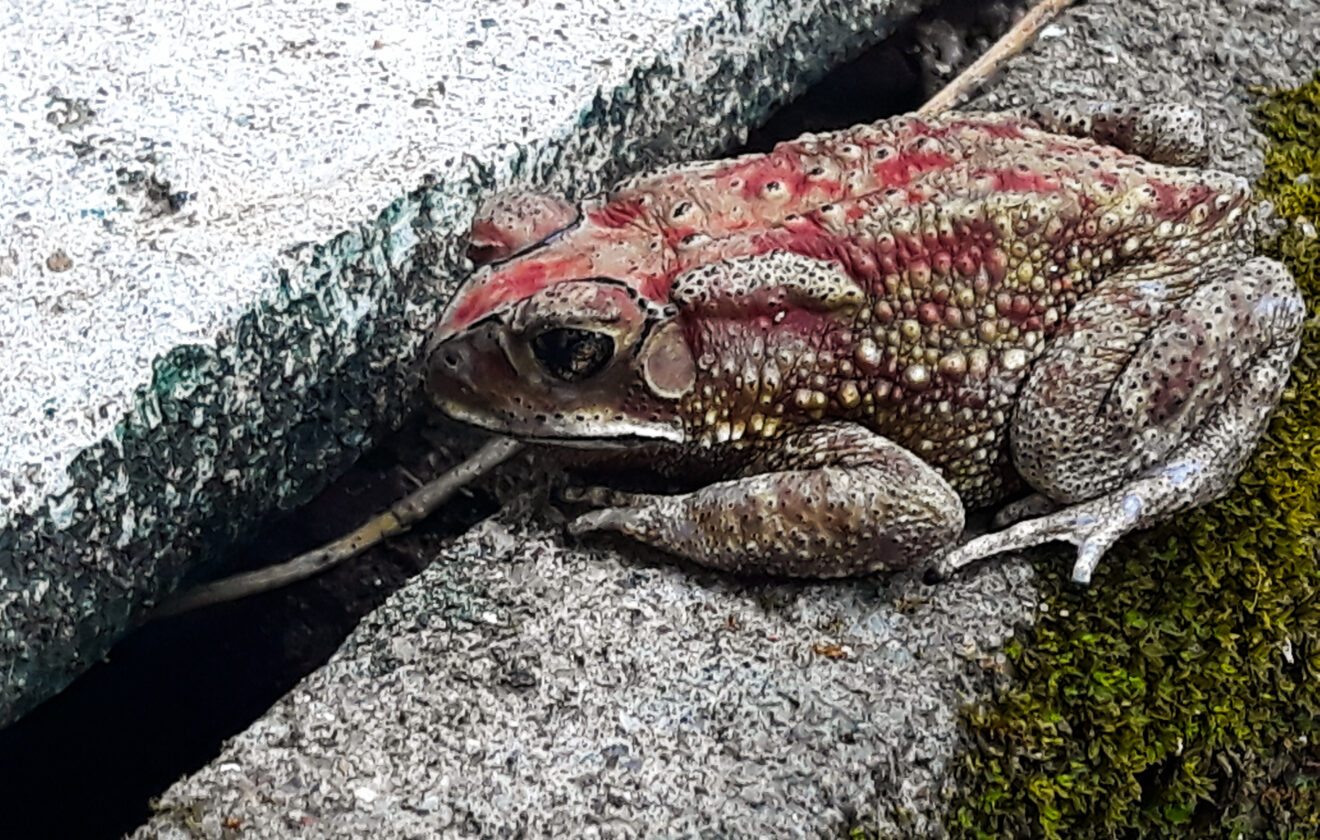
A first glance at an adult Ingerophrynus kumquat reveals an amphibian modestly sized, typically ranging between 30 and 40 millimeters in total length. Their compact, robust bodies appear beautifully textured with a tapestry of fine tubercles and warty protrusions, providing not merely aesthetic intrigue but vital camouflage among leaf-litter and forest debris.
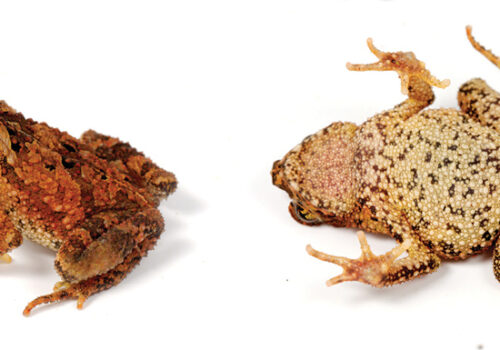
But perhaps the most memorable trait is their striking coloration—a blend of dull olive or chestnut tones interspersed by patches or streaks of vibrant orange or rusted red. It is this bright splash of color, reminiscent of the ripe, brilliant kumquat fruit, that gives the species its evocative common nickname. The interplay of browns and oranges aids in visual disruption, effectively masking it from visually attuned predators.
Evolutionary Adaptations and Survival Strategies#
Beyond coloration, Ingerophrynus kumquat exhibits remarkable adaptive characteristics. Their slender limbs, equipped with sensitive toes, allow precise navigation among cluttered substrates. Their eyes, large relative to their body, grant them sharp nocturnal vision, perfect for nocturnal hunting in low visibility conditions. Furthermore, biochemical investigations suggest mild toxins secreted through their skin glands—subtle chemical defenses effective in deterring potential predators, yet harmless unless ingested in large quantities.
Behavior and Life Cycle: Hidden Rituals of the Forest Floor#
As primarily nocturnal creatures, the daily cycle of the Kumquat Toad is profoundly shaped by twilight and nighttime hours. Under cover of darkness, they emerge from daytime shelters, agilely maneuvering through leaf litter to seek prey. Insects, worms, and small arthropods constitute their primary diet, which they hunt deftly, using both swift tongue extension and a keen visual system.
Mating Rituals and Lifecycle Development#
Annual rains trigger an elaborate and fascinating breeding ritual among Kumquat Toads. Male individuals congregate near shallow pools and subsequently emit delicate, trilling calls—soft, rhythmic sounds drifting melodically through rainforest understories. Females respond to these cues, eventually traveling considerable distances to find suitable mates based on their call’s frequency, volume, and stamina.
After successful mating, hundreds of jelly-coated eggs are meticulously laid in temporary forest pools, convenient places offering reduced predation pressures. The emerging tadpoles undergo approximate two-month developments, gracefully transforming through metamorphosis stages until tiny, vulnerable immature toads crawl gingerly into terrestrial habitats for the first time.
Ecological Role: Guardians of a Delicate Balance#
While diminutive and elusive, the Kumquat Toads play integral ecological roles within Southeast Asian ecosystems. Functioning as both predator and prey, they help maintain arthropod populations—regulating pest insects and providing critical food resources for snakes, birds, and small mammals. Their sensitivity to environmental disturbances also positions them as potential bioindicators, warning signs of subtle habitat changes manifested in shifts within amphibian populations.
Threats and Conservation Status#
Unfortunately, like many other delicate amphibians, the survival of Ingerophrynus kumquat faces substantial threats. Habitat loss stemming from logging, agriculture, urban expansion, and mining is arguably its most pressing issue. Additionally, pollution, climate change, and aquatic habitat modification are contributing to population declines and range contractions across their natural distributions.
Although currently, the species is not formally assessed in the IUCN Red List, regional conservationists consider it vulnerable, citing diminished sightings and habitat fragmentation. Active conservation measures in targeted areas, alongside detailed studies of their ecology, distribution, and population trends, are urgently needed.
Cultural and Scientific Significance#
Though relatively little known culturally and historically beyond scientific and conservation circles, the Kumquat Toad symbolizes Southeast Asia’s hidden biodiversity—small yet significant species that enrich ecosystems and reflect the environmental health of their habitats. Each discovery related to these toads deepens our understanding of amphibian biodiversity and underscores pressing conservation priorities amid regional biodiversity decline.
Conclusion: Championing the Survival of the Kumquat Toad#
The story of Ingerophrynus kumquat encompasses more than a diminutive amphibian dwelling in secrecy. It illustrates critical ecological connections, reveals subtle evolutionary adaptions to rainforest life, and highlights pressing conservation challenges in Southeast Asian habitats increasingly under threat.
By growing our knowledge, raising awareness, and fostering conservation action aligned with local communities and international efforts, we can ensure the continued existence of the Kumquat Toad—a colorful, charismatic, and irreplaceable part of our planet’s wondrous biodiversity tapestry.