- Incilius chompipe: Exploring the Secretive World of Costa Rica's Remarkable Forest Toad
- Taxonomy and Classification: Understanding the Chompipe Toad’s Identity
- Natural Habitat: Emerald Sanctuaries on Rainforest Slopes
- Physical Characteristics: The Art of Camouflage and Survival
- Behavior and Life Cycle: Secretive Amphibians of the Night
- Ecological Importance: Guardians of Forest Balance
- Threats and Conservation Status: Challenges in the Mist
- Cultural and Scientific Significance: Beyond Biology
- Conclusion: Preserving the Chompipe’s Hidden World
Incilius chompipe: Exploring the Secretive World of Costa Rica’s Remarkable Forest Toad#
Hidden among lush rainforest floors, concealed beneath layers of damp foliage and moss-covered logs, a mysterious amphibian thrives quietly, largely unnoticed by the bustling ecosystem surrounding it. This enigmatic creature—the Chompipe toad (Incilius chompipe)—is a species of immense ecological intrigue, and yet, to many, remains little more than a legend whispered among herpetologists and local forest communities alike.
Found exclusively in certain regions of Costa Rica, Incilius chompipe belongs to the charismatic family Bufonidae, a group of terrestrial toads distinguished by their wart-covered skin and intriguing nocturnal behaviors. First identified formally by conservation biologists Savage and Bolaños in 2009, this seemingly modest amphibian fascinated experts with its cryptic nature, peculiar physical qualities, and subtle but crucial role within its delicate forest habitat.
But why does the Incilius chompipe matter so deeply, and how does this humble creature contribute to the complex web of life threading through Costa Rica’s primeval forests? Join me in discovering an amphibian that quietly occupies a unique niche, its journey interwoven with lush habitats, remarkable survival instincts, and pressing conservation challenges.
Taxonomy and Classification: Understanding the Chompipe Toad’s Identity#
The Chompipe toad—scientifically named Incilius chompipe—is a distinctive member of the family Bufonidae, commonly known as true toads. This family is globally diverse, encompassing hundreds of species that exhibit various fascinating adaptations suited to terrestrial life.
In this family, Incilius chompipe belongs to the genus Incilius, a group distinguished by its robust terrestrial behaviour, dry, wart-like skin, pronounced parotoid glands, and typically cryptic coloration to camouflage against the forest floor. The term “chompipe” itself references the locality—Cerro Chompipe—for which the species was named, an homage to the lush region of its discovery in Central Costa Rica.
Genetic analysis and morphological studies position Incilius chompipe closely related to other Incilius species—particularly Incilius epioticus and Incilius melanochlorus, though it boasts unique characteristics enabling biologists to firmly establish it as an entirely separate and distinct species. Exploring these nuances reaffirms how incredibly diverse and ecologically specialized amphibians truly are, especially in biodiverse regions like Central America.
Natural Habitat: Emerald Sanctuaries on Rainforest Slopes#
Incilius chompipe is endemic exclusively to Costa Rica, unfolding its elusive existence at elevations primarily between 1,400 and 1,800 meters above sea level. Its tiny range consists of mist-covered slopes blanketed by lower montane rainforest habitat—an environment rich in moisture, dense leaf litter, moss-coated logs, and shadowy, overgrown ravines. Such habitats provide shelter, abundant resources, and conducive conditions for the species’ survival.
Beneath a Green Canopy: Life in the Leaf Litter#
Peering into this habitat feels akin to stepping into an enchanted world of verdant tranquility. Underfoot, layers of decaying leaves form thick carpets—tapestries of fallen debris offering microhabitats packed with moisture essential for amphibian survival. Hidden amongst decomposing logs and beneath the broad leaves of giant understory plants, these shy animals shelter by day, protected from predation and drying sunlight.
These montane forests possess a unique microclimate characterized by persistently cool temperatures and almost constant humidity, creating optimal conditions for maintaining skin hydration and metabolically supporting survival. The abundant rain, along with small streams and temporary pools that permeate the slopes, provide critical breeding grounds essential for sustaining their populations.
Physical Characteristics: The Art of Camouflage and Survival#
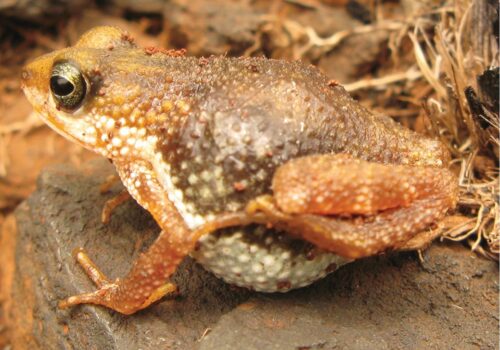
Adeptly blending with its surroundings, Incilius chompipe exhibits subdued coloration dominated by varying shades of olive green, earthy brown, and subtle greys. Its textured skin—richly adorned with warts and bumps—not only aids in camouflage, but also discourages predators that prefer smoother prey.
Adults average between 50 and 70 millimeters in length, making it a modest-sized toad. Despite the species’ humble appearance, closer inspection reveals distinctive reddish-brown undertones and darker patches across its dorsal region. Specialized glands called parotoid glands protrude discreetly behind their eyes, secreting a potent chemical compound that deters predators.
This impressive symphony of subtle coloration and chemical adaptation serves not merely an aesthetic role but is crucial to the toad’s incredible survival strategy. By effectively mimicking their leaf-litter habitats, Incilius chompipe escapes unwanted attention and ensures that day-to-day existence remains discreet, efficient, and ultimately successful.
Behavior and Life Cycle: Secretive Amphibians of the Night#
As dusk descends and shadows deepen in the Costa Rican forest, Incilius chompipe emerges silently from hiding places. Under moonlit nights and cloudy skies, the forest floor hums gently with their carefully tuned nocturnal activities.
A Hunter’s Quiet Pursuit#
While relatively little firsthand observation detailing their precise dietary preferences exists, the feeding patterns of closely related toads give insight into their habits. More often than not, Incilius chompipe likely hunts by stealth, patiently inspecting the leaf litter for small insects, arachnids, and similar arthropods. Equipped with a swift, sticky tongue, the toad efficiently captures prey, fulfilling its critical role as insect predator within this particular ecosystem.
Hidden Rituals of Reproduction#
Understanding the delicate romance of Incilius chompipe remains challenging, given its secretive nature. However, biologists speculate their reproductive habits mirror that of relatives in this genus, involving subtle nocturnal choruses where males congregate near small pools or rain-filled depressions to emit low, musical trills to attract females.
Egg-laying would occur quietly, submerged beneath the waters, safe from moisture loss and predation. Tadpoles known from similar species typically develop rapidly, nourished initially by algae and organic particulates, gradually growing limbs and lungs until their transformation into terrestrial adults, perpetuating the delicate cycle of life.
Ecological Importance: Guardians of Forest Balance#
Living in a habitat hosting extraordinarily high biodiversity, Incilius chompipe plays a subtle yet vital role in maintaining ecological stability. Acting as both predator and prey, the toads help control insect populations, preventing possible outbreaks of certain pest species that could disrupt the delicate ecological balance.
Simultaneously, by providing nourishment to creatures higher up the food chain—such as local snakes, birds, and mammals—the species helps fuel broader food webs. Furthermore, amphibians like Incilius chompipe serve as sensitive environmental indicators, reflecting how changes in climate, pollution, and habitat quality rapidly affect forest ecosystems at large.
Threats and Conservation Status: Challenges in the Mist#
Despite an inherent resilience, Incilius chompipe faces significant threats. Habitat loss resulting from agricultural expansion, logging, and human encroachment rapidly fragments its already confined habitat. Global climate change contributes to shifting rainfall patterns and temperature anomalies that directly threaten the sensitive conditions needed to sustain these toads.
Further complicating matters, diseases such as Ranavirus and the devastating fungal infection chytridiomycosis remain ubiquitous threats in the region, potentially catastrophic for small amphibian populations unless carefully monitored and mitigated.
Though not explicitly evaluated by IUCN, experts stress immediate attention is necessary. Conservation measures underway in Costa Rica highlight the importance of safeguarding primary forest ecosystems, conducting rigorous population monitoring, and public education efforts reinforcing the ecological significance of species like Incilius chompipe.
Cultural and Scientific Significance: Beyond Biology#
Frogs and toads have deep symbolic traditions in Costa Rican culture and Central America. Symbolizing fertility, renewal, and environmental sensitivity throughout indigenous cultures, amphibians such as Incilius chompipe play an essential role in mythology and traditional ecological knowledge. Even scientifically, each amphibian species contributes potentially invaluable discoveries—from novel toxin compounds with medical applications to advanced indicators warning of ecological imbalance.
Conclusion: Preserving the Chompipe’s Hidden World#
The Incilius chompipe, though small and hidden, epitomizes broader themes of biodiversity, ecological sensitivity, and conservation. Protective efforts hinge on deeper understanding and appreciation, bridging scientific study with passionate advocacy from naturalists and concerned citizens alike.
Join in efforts to protect these silent forests, support conservation organizations working on-the-ground in Costa Rica, advocate against habitat destruction, and celebrate the joyful mysteries of nature’s secretive amphibians. Through action and appreciation, we ensure species like Incilius chompipe continue to inspire wonder and fulfill their crucial ecological roles for generations yet to succeed us.