- Ghatophryne rubigina: The Secretive Toad of India’s Western Ghats
- Taxonomy and Classification: Unraveling the Identity of Ghatophryne rubigina
- Natural Habitat: Hidden Kingdom of the Western Ghats
- Physical Characteristics: Unassuming Yet Distinct
- Behavior and Life Cycle: A Life Hidden in Plain Sight
- Ecological Role: The Subtle Balance Keeper
- Threats and Conservation Status: A Species at Crossroads
- Cultural and Scientific Significance: Symbols of Biological Wealth
- Conclusion: Protecting the Quiet Treasures of the Western Ghats
Ghatophryne rubigina: The Secretive Toad of India’s Western Ghats#
In the dense, mist-laden forests cloaking India’s Western Ghats, a small, elusive amphibian moves quietly across damp leaf litter, barely noticeable amidst the rich tapestry of green and brown that characterizes this biodiversity hotspot. This is the silent realm of Ghatophryne rubigina, a captivating yet relatively obscure species known commonly as the rubiginous toad. Shrouded in mystery and immensely intriguing, this diminutive creature holds a vital role within its delicately balanced ecosystem, demonstrating nature’s ability to carve niches even in hidden corners of our planet.
Unlike the flamboyant poison dart frogs of the Amazon or the boisterous bullfrogs that vocalize readily in wetlands worldwide, Ghatophryne rubigina thrives in subtle anonymity. However, beneath its modest exterior lies a fascinating biology, vital ecological connections, and pressing conservation implications that make it worthy of recognition and protection.
Taxonomy and Classification: Unraveling the Identity of Ghatophryne rubigina#
Ghatophryne rubigina belongs to the family Bufonidae, which includes numerous common toads characterized by dry, textured skin and a terrestrial way of life. Bufonidae is a diverse global family, housing familiar species like the common toad (Bufo bufo) and the American toad (Anaxyrus americanus).
The genus Ghatophryne, however, is uniquely localized to India’s biologically lush Western Ghats—an ancient mountain range stretching along India’s western edge. Ghatophryne comprises a small number of endemic species, each adapted to specialized niches in these dense forests and montane networks.
Described relatively recently by Pillai & Pattabiraman in 1981, Ghatophryne rubigina earns its specific epithet “rubigina,” derived from the Latin word “rubiginosus,” meaning “rust-colored,” aptly capturing this species’ distinctive and subtle coloration.
Natural Habitat: Hidden Kingdom of the Western Ghats#
An Exclusive Range#
Ghatophryne rubigina is unequivocally linked to the Western Ghats biodiversity hotspot, exclusively found in a narrow geographical strip within this region’s southern part. Its presence is predominantly recorded in moist, evergreen, and montane forests, often with dense canopy cover, creating a twilight world beneath sun-dappled leaves and towering trees.
Due to its specialized habitat requirements and elusive behavior, sightings are sparse and typically recorded near slow-moving streams, accumulated leaf litter, and moss-draped rocks. The cool, humid conditions of the Ghats’ subtropical and montane forests provide the ideal microclimates, sheltering this remarkable amphibian from harsh sunlight and rapid evaporation, crucial for amphibian survival.
A Fragile Microhabitat Dependency#
Amphibians like Ghatophryne rubigina maintain sensitive relationships with their surroundings. Their physiology demands high moisture levels, and the damp leaf litter carpets of forest floors provide the ideal habitat, not only helping them retain moisture but also affording the concealment necessary to evade predators and facilitate ambush hunting tactics. The streams and freshwater seeps serve as critical breeding grounds, driving their modest but important life cycle.
This tight ecological bond underscores the reciprocal relationship between the forests of the Western Ghats and their amphibian residents. Changes to forest cover, microclimate alterations, or upstream pollution can ripple through the delicate web of interactions and threaten this sensitive species.
Physical Characteristics: Unassuming Yet Distinct#
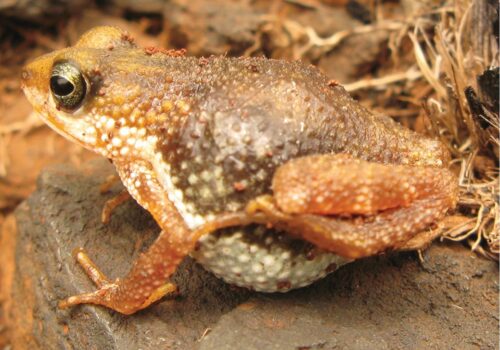
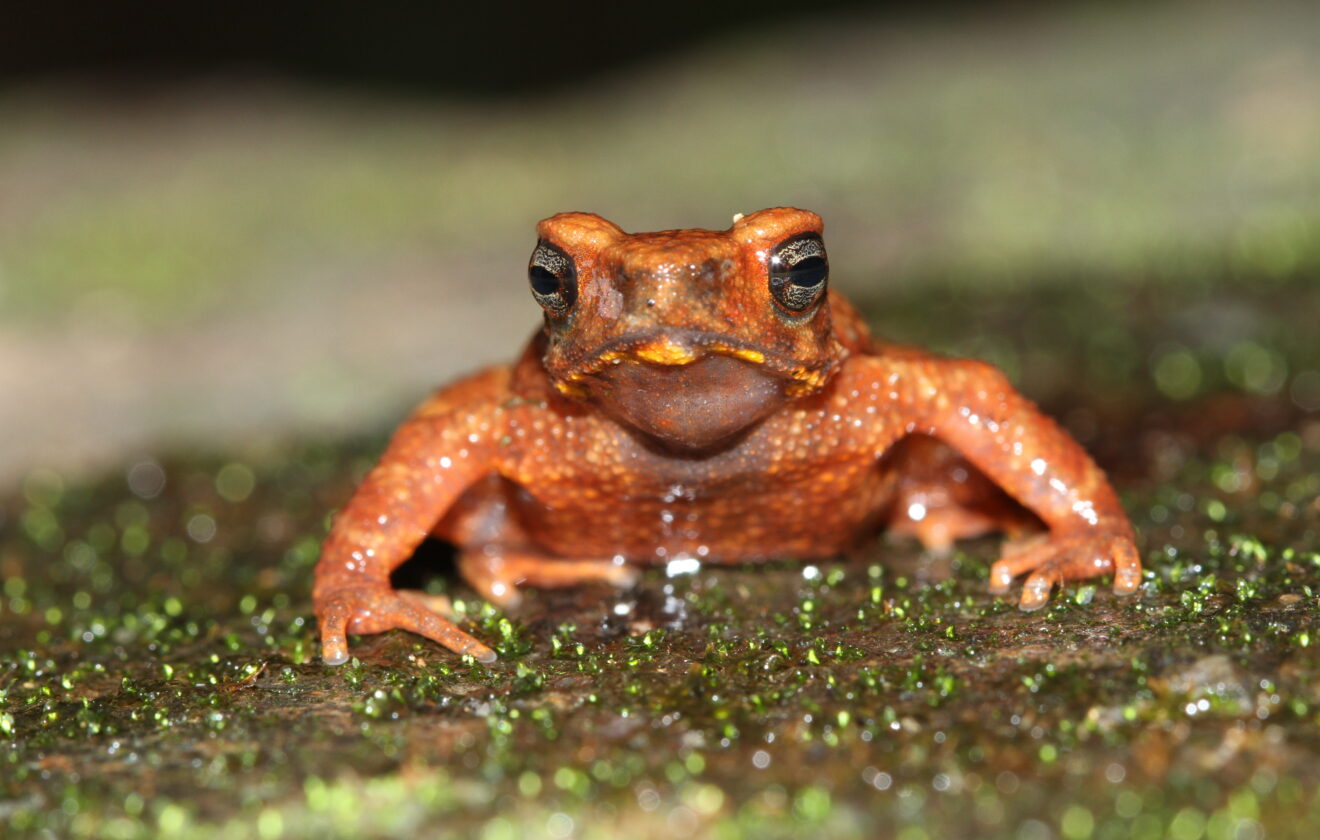
The rubiginous toad rarely captures initial attention, its understated appearance lending itself readily toward camouflage. Measuring a modest 25 to 40 millimeters in length as adults, this pint-sized amphibian sports cryptic coloration that ranges from reddish-brown to dull rust hues, mirroring exactly the decaying organic palette of leaf litter.
The toad’s textured skin is flecked with darker blotches and bumps, providing excellent mimicry against the damp forest floor. These lumps, although seemingly minor details, significantly complicate predators’ attempts to distinguish their prey from background vegetation. The subtle shades and varied texture of their skin confer powerful camouflage benefits, merging its body seamlessly with the forest substrate.
One distinctive aspect is their relatively short and powerful limbs adapted ideally for terrestrial locomotion. Unlike their tree-favoring frog counterparts, rubiginous toads are steadfastly grounded, spending most of their activities quietly exploring or hunting on soil and moss-covered rocks, rarely venturing upward except when terrain dictates refuge.
Behavior and Life Cycle: A Life Hidden in Plain Sight#
Secretive Hunters of the Forest Floor#
Ghatophryne rubigina anchors its nightly routines in careful, stealth-driven predation. Utilizing a sit-and-wait approach, these amphibians patiently stake out prime locations brimming with potential prey, primarily tiny insects and arthropods more diminutive than themselves, including ants, beetles, and termites.
A rapid flick of their sticky tongues surprises their prey in mere milliseconds, an exemplification of the quiet drama hidden amidst the forest floor’s shadowy tapestry. Their stealthy, unassuming nature makes their predation strategy incredibly successful, ensuring their survival in such specialized habitats.
A Quiet Courtship in Forest Streams#
Once monsoons shower the Ghats with heavy rainfall, signaling optimal breeding conditions, Ghatophryne rubigina adults congregate near forest streams and quiet pools. Unlike more vocal amphibians that depend heavily on loud croaks to attract mates, rubiginous toads practice subdued courtship rituals.
Male rubiginous toads emit subtle vocalizations—quiet, restrained calls audible only over short distances—reducing the risk of alerting predators and blending seamlessly into background nighttime chorus. Females approach cautiously, responding subtly while selecting suitable partners hidden among wet leaves and pebbled substrates. After mating, they deposit strings of jelly-coated eggs in protected, slow-moving waters, optimizing hatchling survival.
Tadpoles Navigating a Delicate Existence#
Rubigina tadpoles soon hatch, entering a precarious world teeming with predators. These larvae quickly scatter among submerged vegetation, feeding stealthily on algae and microorganisms, their coloration and shy behavior supporting survival. Within weeks, these resilient tadpoles metamorphose into juveniles, assuming terrestrial lifestyles and disappearing into forest shadows to perpetuate quiet lifecycles anew.
Ecological Role: The Subtle Balance Keeper#
Despite their diminutive stature, amphibians like Ghatophryne rubigina are pivotal ecological contributors, holding diverse predator-prey relationships within complex forest webs. As insectivorous hunters, they help balance insect populations, indirectly protecting forest vegetation from potential herbivore explosions.
Simultaneously, rubiginous toads themselves provide food for reptiles, birds, small mammals, and aquatic organisms, underlining their interconnectedness within this biodiverse ecosystem. Importantly, their health—and notably their declines—often signal ecosystem distress, qualifying amphibians as proverbial “canaries in coal mines” for environmental monitoring.
Threats and Conservation Status: A Species at Crossroads#
Despite limited population data due to their cryptic nature, habitat destruction ranks as the primary threat threatening Ghatophryne rubigina. Deforestation driven by agriculture, plantations, logging, and infrastructure growth significantly encroaches upon their specialized montane habitats, distressing breeding sites and damp forest floor home ranges.
Climate alterations and shifts in monsoon patterns represent longer-term threats, disrupting breeding cycles and influencing moisture-dependent habitats. Although classified as Near Threatened by the IUCN Red List, preserving Ghatophryne rubigina requires concerted habitat protection and continued research into distribution, behavior, and biology.
Cultural and Scientific Significance: Symbols of Biological Wealth#
The Western Ghats, revered locally for their spiritual symbolism and reservoirs of biodiversity, treat amphibians like Ghatophryne rubigina as emblems of ecological integrity. Securing these unobtrusive gems ensures resilience and stability of biodiversity, while continued scientific research provides deeper insights into their toxin potential, physiological adaptations, and climate sensitivity.
Conclusion: Protecting the Quiet Treasures of the Western Ghats#
Embracing conservation of discreet species like Ghatophryne rubigina requires mindful stewardship of their fragile ecosystems. As ambassadors of the planet’s quiet biodiversity treasures, their continued existence depends heavily upon humanity’s ability to respect habitat integrity and champion environmental preservation—for if they vanish unheeded, we lose biological voices whose whispers are uniquely vital to nature’s magnificent symphony.