- Introduction: Meet the Mysterious Red-Eyed Tree Toad
- Taxonomy and Classification
- Natural Habitat: A Hidden Realm in the Atlantic Forest
- Physical Characteristics: An Amphibious Gem of the Rainforest
- Behavior and Life Cycle: Intricate Strategies for Survival
- Ecological Role: Guardians of the Canopy Microcosm
- Threats and Conservation Status: Battling for Survival
- Cultural and Scientific Significance: Amphibians as Symbols and Sentinels
- Conclusion: Protecting A Jewel of Brazil’s Forested Heartlands
Introduction: Meet the Mysterious Red-Eyed Tree Toad#
Deep in the lush Atlantic forests of northeast Brazil, among the thick foliage, moss-laden branches, and soft humus-laden soil, lives a creature as captivating as it is mysterious—the Frostius erythrophthalmus, commonly known as the red-eyed tree toad. With its scientific name evoking imagery of frost and fiery eyes, this small amphibian surprises and delights nature enthusiasts who venture into its humid, tropical territories.
Despite its modest size and elusive habits, the red-eyed tree toad stands as a vibrant testament to the remarkable diversity and delicate ecological balance of Brazil’s rapidly diminishing rainforest habitats. But beyond its captivating crimson gaze and cryptic lifestyle lies a creature with a fascinating biology, and a critical ecological role that we are only just beginning to fully understand.
Join us on an immersive journey as we explore the elegant complexities of the Frostius erythrophthalmus, uncover its secrets, and examine the profound significance this amphibian has on its ecosystem and the world beyond.
Taxonomy and Classification#
Scientifically designated as Frostius erythrophthalmus, this little-known amphibian belongs to the family Bufonidae—the true toads. Within this expansive family, the genus Frostius comprises only a small group of closely related species endemic to the tropical rainforests and mountainous regions of South America, particularly Brazil.
The species name “erythrophthalmus” originates from ancient Greek—”erythros” meaning red, and “ophthalmos” meaning eyes, perfectly describing its most striking physical characteristic. First scientifically described by British zoologist George Albert Boulenger in 1903, Frostius erythrophthalmus has intrigued biologists with its uncommon appearance and limited geographic range, distinguishing it as an important subject of ecological study and conservation concern.
Natural Habitat: A Hidden Realm in the Atlantic Forest#
The captivating red-eyed tree toad calls the Atlantic forest ecosystems of northeastern Brazil its exclusive home, specifically thriving in coastal and mountainous humid forests ranging from the state of Bahia up to the Pernambuco region. These unique tropical forests, defined by their moisture-rich air and shaded understory, offer ideal conditions for an amphibian that depends heavily on delicate moisture balances to survive.
Habitat Preferences And Microhabitats#
Within its primary habitat, Frostius erythrophthalmus demonstrates a distinct affinity for elevated microhabitats, typically found perched upon mossy branches, lichen-covered trunks, or sheltered in the bromeliads and leaf axils high above the damp forest floor. This arboreal lifestyle shields it from ground-level predators and maintains its delicate skin moisture, providing ideal breeding and foraging opportunities.
Notably, its survival is intimately connected with bromeliad plants, as their leaf bases act as miniature aquatic nurseries that sustain tadpoles until they reach maturity. Such specialized reproductive strategies make the species particularly vulnerable to habitat alterations, placing it among key indicator species that reflect overall ecosystem health.
Physical Characteristics: An Amphibious Gem of the Rainforest#
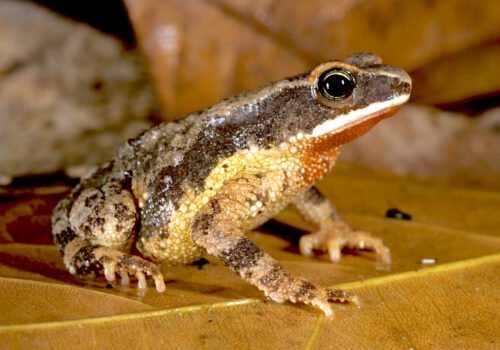
The red-eyed tree toad is undoubtedly arresting at first sight, often leaving observers momentarily breathless. Compact and petite, adults rarely surpass 30 millimeters in length, yet despite their modest stature, they radiate an unmistakable charisma. Their most prominent feature—the bold crimson-red eyes—commands attention, lending this otherwise cryptic creature an undeniable charm.
Their body coloration cleverly reflects the tones of their habitat; mottled shades of olive-green, subtle yellows, dark browns, and pale creams, which serve as perfect camouflage within their forest environment. Darker blotches and intricate patterns further enhance their disguise, allowing them nearly seamless integration within the dappled shadows of their mossy abode.
Their limbs, equipped with specialized adhesive pads and elongated finger-like digits, afford impeccable climbing and clinging capabilities suited to arboreal lifestyles. Furthermore, their textured skin, covered with minute glands, provides moisture retention capabilities, critical to survival amid fluctuating forest humidity.
Behavior and Life Cycle: Intricate Strategies for Survival#
Frostius erythrophthalmus embodies the elegance of adaptive evolution, displaying behaviors highly attuned to its ecological niche. Primarily nocturnal, these tree toads spend daylight hours cleverly concealed within protective alcoves, moss carpets, or the folds of epiphytic plants, emerging under the safety of darkness to forage on a diverse menu of insects and arthropods. Expert ambushers, they masterfully capitalize on their phenomenal camouflage, patiently awaiting unsuspecting prey before striking swiftly and calculatingly.
The Rituals of Reproduction#
With the seasonal onset of rains comes the symphony of vibrant mating calls; males perch strategically to broadcast resonating, well-defined calls that echo subtly through humid forest canopies. Females, attracted by the resonant chorus, select partners based upon vocal vigor and territory quality. Upon pairing, the female carefully deposits small clusters of gelatinous eggs into the water-filled leaf axils of bromeliads.
Their tadpoles, shielded within these delicate aquatic nurseries, begin life entirely dependent on nutrient-rich detritus and microorganisms accumulated within these miniature ecosystems. In a mere few weeks, tadpoles complete metamorphosis, emerging as miniature replicas of their parents, perfectly adapted for arboreal life amidst the intricate forest canopy layers.
Ecological Role: Guardians of the Canopy Microcosm#
Though small and often overlooked, Frostius erythrophthalmus holds monumental significance within its ecosystem. As insectivorous predators, they effectively regulate populations of various invertebrates, thereby playing key roles in balancing forest food webs. Their presence supports the maintenance of biodiversity at multiple trophic levels.
Additionally, their restricted and highly specialized breeding strategy closely links them with bromeliad plants, highlighting an intricate mutualistic relationship where each species contributes positively to the presence and lifecycle of the other. Their population health thus indicates broader ecological dynamics, signaling the overall health and stability of forest ecosystems in northeastern Brazil.
Threats and Conservation Status: Battling for Survival#
Sadly, like many amphibian species worldwide, Frostius erythrophthalmus faces significant threats, foremost among them being habitat loss due to rampant deforestation, destructive agricultural practices, and urban development. The shrinking of Brazil’s Atlantic forests—historically among the most biodiverse ecosystems on earth—presents the most immediate peril, pushing numerous species toward precarious conservation status.
While specific population trends for Frostius erythrophthalmus remain inadequately documented, the International Union for Conservation of Nature (IUCN) classifies the species currently as Data Deficient, reflecting the urgent need for more comprehensive field research.
Increasingly, conservationists advocate for habitat preservation, climbing the diplomatic and social hills necessary to protect forest patches and wildlife corridors crucial to the species’ ongoing survival. Awareness campaigns strive to mobilize public opinion and secure governmental commitments to protect unique areas harboring significant biological diversity.
Cultural and Scientific Significance: Amphibians as Symbols and Sentinels#
In local contexts, Frostius erythrophthalmus, like many frogs and toads, occasionally represents ecological resilience and regeneration. Captivating in appearance, indigenous storytelling often attributes to amphibians symbolic significance, highlighting their sensitive relationship to ecological harmony and wet-season renewal.
Scientists, too, increasingly view amphibians as invaluable ecological sentinels—”canaries of the amphibious coal mine,” warning against invisible environmental threats such as pollutants, climate change, and emergent diseases. Observing populations of red-eyed tree toads thus yields essential early indications of both local and global ecological disruptions, reinforcing their importance not merely in biological understanding but in conservation advocacy as well.
Conclusion: Protecting A Jewel of Brazil’s Forested Heartlands#
From its vivid crimson eyes and graceful arboreal elegance to its beautifully specialized ecological relationships, Frostius erythrophthalmus stands unmatched in tropical forests as a symbol of biodiversity’s marvelous intricacies. Like many amphibians, these charming creatures deserve our deepest admiration, our efforts to understand them, and above all, a committed dedication to protecting their dwindling habitats.
Let this red-eyed tree toad inspire us to action—to educate others, support conservation initiatives, and appreciate the profound, irreplaceable beauty amphibians bring to our planet’s tapestry of life.