Introduction: Meet the Natterjack Toad#
On mild spring evenings in coastal dunes and sandy heathlands across Europe, a distinctive rhythmic trill breaks the silence. Delivered with clockwork-like consistency, the loud, persistent call carries through the twilight, signaling the presence of the charismatic Epidalea calamita, known commonly as the Natterjack Toad. With its remarkable ability to thrive precisely in the environments most amphibians find inhospitable, this small yet charming toad inhabits a unique ecological niche worthy of attention.
Scientifically dubbed Epidalea calamita, the Natterjack Toad stands apart from its amphibian cousins through a series of unusual behaviors and adaptations. Considered Europe’s loudest amphibian, with calls audible over vast distances, this species’ compelling biology, curious behavior, and conservation challenges combine to tell a remarkable story — a tale highlighting both vulnerability and resilience amidst an ever-changing European landscape.
Taxonomy and Classification#
The Natterjack Toad belongs to the family Bufonidae, a widely distributed and diverse group of frogs known commonly as true toads. Within Bufonidae, it falls under the genus Epidalea, setting it slightly apart from species in the common toad genus Bufo.
Its classification breakdown reads as follows:
- Kingdom: Animalia
- Phylum: Chordata
- Class: Amphibia
- Order: Anura
- Family: Bufonidae
- Genus: Epidalea
- Species: Epidalea calamita
The closest relatives include the Common Toad (Bufo bufo) and Green Toads (Bufotes viridis complex). However, Epidalea calamita stands out distinctly by both behavior and ecological adaptations that set it aside from these close cousins, offering fascinating insights into amphibian evolution and ecological specialization.
Natural Habitat#
Geographic Range and Distribution#
The Natterjack Toad ranges widely across Western and Central Europe, spanning from southern Britain and the Iberian Peninsula eastward through France, Germany, Switzerland, and Netherlands to southern Scandinavia. Its distribution is somewhat patchy, scattered across suitable habitats such as coastal dunes, sandy heaths, and occasionally open agricultural land with sparse vegetation.
Preferred Habitats#
Epidalea calamita thrives specifically in sandy or rocky soils with sparse vegetation. Remarkably adapted to withstand dry conditions compared to other amphibians, the toad explicitly avoids heavily forested areas or dense grasslands. Instead, it favors open, sun-exposed habitats providing loose soils essential for burrowing and shallow, ephemeral pools crucial for breeding.
These ecosystems, such as coastal dunes, sandy heaths, quarries, gravel pits, and lowland sandy grasslands, offer ideal settings for the Natterjack’s unique lifestyle. With reduced competition from other amphibians (more dependent on consistent wetness), these challenging environments grant the species a competitive advantage, illustrating the delicate balance of evolutionary adaptation and environmental preference.
Physical Characteristics#
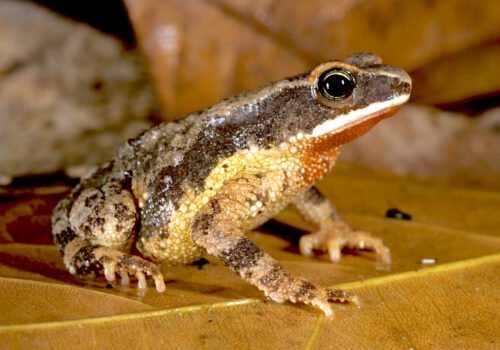
Surprisingly small, adult Natterjack Toads rarely exceed 7-8 centimeters in length. Compact yet robust, their short hind legs lend themselves less to impressive jumps and more to running in rapid, mouse-like bursts — an unusual mode of locomotion among amphibians.
The toad’s skin bears multiple wart-like bumps, a distinctive feature of true toads, offering both camouflage and mild protective toxin secretion. Their greyish-green or brown coloration, typically mottled and patterned with darker spots or blotches, grants them perfect camouflage against the sandy landscape where they live.
Perhaps most striking is the distinctive bright yellow, creamy stripe extending down the center of the toad’s back. This easily identifiable line serves potentially as recognition for mates or deterrent to predators. Large emerald-green eyes with horizontally slit pupils further aid their nocturnal and dusk activity.
Behavior and Life Cycle#
Diet and Hunting Strategies#
As mainly insectivorous predators, Epidalea calamita feeds primarily at night on beetles, ants, spiders, and moth larvae. Using quick, forward lunges aided by sticky tongues, these opportunistic toads forage efficiently around dusk and after dark when their prey is most active. Their ability to move rapidly on sandy terrain grants them a decisive advantage, compensating for their comparatively limited climbing or swimming capabilities.
Breeding Habits and Vocalization#
The breeding season of Natterjack Toads falls between late March and July, often dictated by rainfall and ambient temperatures. Crucially tied to ephemeral water bodies formed by seasonal rains, breeding pools are warm, shallow, and devoid of predatory fish, providing ideal spawning conditions.
Males congregate nightly along these pools, delivering their famously loud, distinctive “ratchet-like” trill. Impressively, these calls can travel several kilometers, drawing females and clearly delineating territory among competing males. After mating, females lay egg strings numbering around 2,000 to as high as 7,500 eggs, deposited rapidly into shallow water where they hatch quickly due to rapid development.
Tadpole Development and Metamorphosis#
Quick development is another unique adaptation. Natterjack tadpoles metamorphose at impressive speeds, crucial given that their temporary pools dry quickly. Within just six to eight weeks, tadpoles transform into tiny juvenile toads, marking the next generation ready to face the uncertainties of their delicate environment.
Ecological Role#
The Natterjack fulfills a crucial ecological niche. Primarily insectivorous, it directly limits pest populations, contributing significantly to ecological balance within the landscape. Simultaneously, as prey themselves, they support diverse predators, including snakes, birds, mammals, and larger amphibians, thereby anchoring a substantial food web.
Their existence also signals ecological health. As amphibians sensitive to environmental change, declines in Epidalea calamita can indicate wider issues such as pollution, declining habitat quality, or climate shifts — marking them as excellent bioindicators for ecosystem monitoring.
Threats and Conservation Status#
Despite their adaptability, Epidalea calamita populations have faced significant declines resulting mainly from habitat loss, fragmentation, land use changes, and pollution. Agricultural intensification, urban expansion, and drainage of breeding pools severely reduce available habitats. Additionally, climate change’s unpredictable weather threatens their perfectly timed breeding cycles.
The IUCN currently classifies the Natterjack Toad as Least Concern; however, regional populations exhibit marked declines, highlighting localized vulnerabilities. Conservation efforts focus prominently on habitat restoration, management of ephemeral pools, and ensuring open habitats remain plentiful across their range. European volunteers and dedicated conservation groups diligently monitor sites, safeguarding valuable habitats to protect this intriguing amphibian.
Cultural and Scientific Significance#
Culturally, Epidalea calamita holds peculiar significance, often symbolizing resilience or adaptability in folklore. Historically, their loud calls sparked beliefs or superstitions relating to weather forecasting, agricultural cycles, or even spiritual omens across diverse European traditions.
Scientifically, the species offers exciting insights into physiological adaptations allowing survival in challenging conditions. Their ability to rapidly develop into metamorphosed adults in ephemeral pools provides researchers remarkable opportunities to investigate evolutionary strategies, stress tolerance, and even climate adaptation processes.
Conclusion: Safeguarding the Future of Epidalea calamita#
Ultimately, the story of the Natterjack Toad, Epidalea calamita, emerges as one of adaptation, resilience, and vulnerability within quickly changing European environments. This remarkable species illustrates the balance between evolutionary advantage and environmental challenge, reminding us of the continuous interplay shaping wildlife survival.
By fostering public awareness, supporting conservation initiatives, and ensuring protection of their delicate habitats, we safeguard not merely Epidalea calamita itself but also valuable ecological webs and biodiversity across Europe’s landscapes. Take an active role, appreciate the amphibious wonders like the Natterjack Toad, and participate or support conservation efforts within your localities.