- The Long-Nosed Forest Toad (<em>Dendrophryniscus proboscideus</em>): Unveiling the Secrets of a Rainforest Enigma
- Taxonomy and Classification: A Remarkable Lineage in Miniature
- Natural Habitat: The Fragile Realm of the Atlantic Rainforest
- Physical Characteristics: The Curious Charisma of a Unique Amphibian
- Behavior and Life Cycle: Quiet Lives of a Forest Floor Specialist
- Ecological Role: Amphibian Guardians of Biodiversity
- Threats and Conservation Status: An Amphibian in the Eye of the Storm
- Conclusion: Protecting an Iconic Species Amid The Forest Shadows
The Long-Nosed Forest Toad (Dendrophryniscus proboscideus): Unveiling the Secrets of a Rainforest Enigma#
Deep within the lush undergrowth of the Atlantic forests of Brazil resides a master of disguise, an amphibian whose oddly captivating features set it apart from its more conventional cousins: the Long-Nosed Forest Toad, scientifically known as Dendrophryniscus proboscideus. This unique little toad has long captured the imagination of naturalists and curious wildlife enthusiasts alike, largely due to its prominent “nose,” a curious appendage that gives it its common name and has inspired countless questions about its ecological and evolutionary significance.
While relatively obscure to the general public, the Long-Nosed Forest Toad stands as a charismatic symbol of the biological riches of Brazil’s rapidly diminishing Atlantic Rainforest. Not only is this tiny amphibian an extraordinary example of evolutionary adaptation, but it also serves as a sensitive indicator of environmental health, quietly signaling the conditions of its rainforest home. Before diving deeper into the frog’s biology, behaviors, and conservation story, let us first examine precisely where this curious creature sits in the interconnected web of life.
Taxonomy and Classification: A Remarkable Lineage in Miniature#
Dendrophryniscus proboscideus, known colloquially as the Long-Nosed Forest Toad or Proboscoid Toadlet, belongs to the Bufonidae family, a diverse group commonly referred to as “true toads.” Yet, the genus Dendrophryniscus actually differs significantly in habits and habitats compared to most true toads, having adapted to specialized microhabitats and vibrant forest ecosystems.
First described scientifically by researchers Edward Drinker Cope in 1862, the species derives its genus name from the Greek words “dendro,” meaning “tree,” and “phrynos,” meaning “toad.” Although categorized within Bufonidae, these toads exhibit distinctively different lifestyles from their larger, ground-dwelling relatives. Within its genus—Dendrophryniscus—this species is particularly unusual due to the exaggerated extension of its snout into a pronounced proboscis-like structure, adding another layer of intrigue to its already fascinating biology.
Occasionally, taxonomic revisions shake the amphibian tree of life, but thus far, Dendrophryniscus proboscideus has consistently maintained its recognized classification, holding firmly to its unique niche among Brazilian amphibians.
Natural Habitat: The Fragile Realm of the Atlantic Rainforest#
The Atlantic Rainforest, with its tapestry of dense vegetation, sparkling streams, and mist-entwined valleys, perfectly suits the specialized needs of Dendrophryniscus proboscideus. Scientists and naturalists searching for these elusive amphibians find themselves navigating through one of Earth’s biodiversity hotspots—a region rich in species but simultaneously threatened by deforestation, urban expansion, and agriculture.
This toadlet is primarily confined to the humid lowland and mountainous rainforest interiors of Brazil’s Atlantic Forest biome, particularly concentrated around the states of Rio de Janeiro, São Paulo, Paraná, and Santa Catarina. The species prefers habitats characterized by consistent moisture, ample leaf litter, fern-covered boulders, and damp forest floors. It typically inhabits relatively undisturbed forests, thriving in conditions that offer ample shelter and a stable microclimate.
The microhabitats frequented by the Long-Nosed Forest Toad are aesthetically stunning yet also architecturally complex—ferns and mosses wrapping stone outcrops, fallen tree trunks moist from perpetual humidity, and leaf litter concealing thousands of insects that provide a reliable food source for this tiny predator.
Physical Characteristics: The Curious Charisma of a Unique Amphibian#
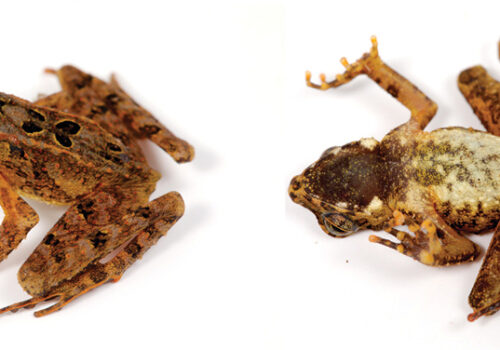
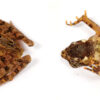
What first fascinates anyone encountering Dendrophryniscus proboscideus is undeniably its distinguishing feature—the elongated, horn-like projection at the tip of its snout. While measuring just 20 to 25 millimeters in length, these minute, charismatic amphibians possess intricate adaptations that diverge dramatically from more familiar amphibian faces.
Its coloration, a subtle tapestry of browns, greens, grays, and ochres, offers impeccable camouflage amid the leaf litter and moss-covered trunks. Irregular markings and mottled spots further enhance their capability to blend harmoniously with their surroundings. To the untrained eye, a stationary Long-Nosed Forest Toad may appear indistinguishable from a piece of moss-covered bark or a fallen leaf.
Recent hypotheses suggest that the strange nasal appendage might serve various ecological purposes. Some herpetologists theorize its role in aiding camouflage among moss and lichens, acting as disruptive visual patterning. Other suggestions connect the pronounced snout shape to behavioral displays during courtship or territorial confrontations, though detailed studies remain limited. However, its conspicuousness draws attention from researchers seeking deeper insights into the evolutionary pressures shaping such uniquely prominent features.
Behavior and Life Cycle: Quiet Lives of a Forest Floor Specialist#
Feeding Strategies and Adaptations#
Like many amphibians of its size, the Long-Nosed Forest Toad is primarily insectivorous, feasting voraciously on ants, termites, small beetles, spiders, and other tiny invertebrates inhabiting the moist leaf litter. Its hunting strategy leans heavily into its protective coloration and sedentary behavior. Rather than actively pursuing prey, these toads demonstrate patient ambush tactics. They remain incredibly still, blending seamlessly with their surroundings until an unsuspecting meal ventures close enough for a swift, opportunistic strike.
A Secretive Breeding Cycle#
Perhaps even more fascinating—and sometimes frustrating for researchers—is the elusive and secretive breeding behavior of these tiny amphibians. Male Long-Nosed Forest Toads utter low-intensity yet rhythmic chirping calls during rainy periods to attract females. Mating activities predominantly occur during wet seasons or after substantial rainfall triggers breeding events.
Females lay small clusters of eggs in damp, secluded areas, typically tucked away in tiny crevices of waterlogged leaf litter or damp cavities beneath moss-covered rocks. Tadpoles emerge shortly afterward, initiating their larval development in small water bodies—often mere puddles or depressions retaining sufficient moisture.
Although still understudied, it is presumed these tadpoles mature rapidly due to unpredictable moisture conditions in their habitat, requiring quick metamorphosis within a short, moisture-abundant window, optimizing their odds of survival.
Ecological Role: Amphibian Guardians of Biodiversity#
Though small in stature, Dendrophryniscus proboscideus occupies an outsized ecological role within the Atlantic Rainforest ecosystem. As insect predators, these tiny amphibians regulate insect populations, contributing to maintaining ecosystem balance. Furthermore, their role as prey sources for larger predators—including birds, reptiles, larger amphibians, and even small mammals—further signifies their ecological importance within tangled food webs.
Additionally, scientists view the presence and abundance of these amphibians as bio-indicators—organisms whose health closely mirrors habitat conditions. Their sensitivity to habitat degradation, pollution, and climate fluctuations positions them as crucial indicators for ecosystem health and conservation interventions.
Threats and Conservation Status: An Amphibian in the Eye of the Storm#
According to the International Union for Conservation of Nature (IUCN), Dendrophryniscus proboscideus currently holds a “Least Concern” designation. Nonetheless, the ongoing degradation of its Atlantic Rainforest habitat represents an escalating threat. Human activities, including agriculture encroachment, urbanization, logging, and climate change-induced droughts, progressively fragment their environment, restricting their populations to increasingly isolated “islands” of suitable habitat.
Conservation organizations and Brazilian environmental agencies actively stress the importance of protecting remaining sections of the Atlantic Rainforest. Community-driven restoration and reforestation projects offer potential hope in restoring essential habitats and connectivity corridors for amphibian resilience. Citizen science initiatives, research-driven understanding of the amphibian’s life cycle, and public environmental education further strengthen lasting conservation efforts.
Conclusion: Protecting an Iconic Species Amid The Forest Shadows#
The Long-Nosed Forest Toad, enigmatic master of camouflage and symbol of fragile ecosystems, quietly invites us all to marvel at biodiversity’s astounding intricacies. By understanding and promoting the conservation of fascinating species such as Dendrophryniscus proboscideus, we secure a brighter future not just for toads but for millions more hidden wonders within Earth’s magnificent forests.
Let these tiny lives inspire us to contribute to conservation awareness, support local and global efforts, and appreciate profoundly the incredible diversity of life that surrounds us.