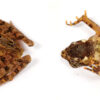
Dendrophryniscus cuca — Unveiling the Secret Lives of Brazil’s Rare Forest Toad#
Hidden beneath a dense carpet of fallen leaves and surrounded by lush, moisture-laden vegetation deep within Brazil’s Atlantic Rainforest, a peculiar amphibian rarely glimpsed by outsiders makes its home. Known scientifically as Dendrophryniscus cuca, this small forest toad resonates with both mystery and wonder, captivating scientists and nature enthusiasts fortunate enough to encounter it.
Named intriguingly after a mythical folk entity from Brazilian folklore—the fearsome, mysterious “Cuca”—this diminutive amphibian might initially seem less imposing than its legendary namesake. Yet, beneath its modest appearance lies a host of fascinating biological adaptations and ecological peculiarities, earning it a rightful place among the wondrous creatures calling Brazil’s forests home.
Taxonomy and Classification#
Dendrophryniscus cuca is a species of toad belonging to the Bufonidae family, specifically within the distinctive genus Dendrophryniscus, renowned for their intriguing arboreal tendencies and specialized forest adaptations. The genus name “Dendrophryniscus” cleverly reflects their life entwined with forest vegetation, combining Greek “Dendro” meaning “tree,” and “Phryniscus,” referring loosely to small toads.
First scientifically described in 2008, Dendrophryniscus cuca stands among a small, specialized lineage recognized for their rarity, cryptic coloration, and highly specialized niches within Brazilian ecosystems. Close relatives include species such as Dendrophryniscus brevipollicatus and Dendrophryniscus leucomystax, all specialists of forested habitats primarily restricted to the tropical Americas.
Natural Habitat and Distribution#
The story of D. cuca unfolds amidst one of the world’s richest yet most imperiled ecosystems—the Atlantic Forest biome that adorns the eastern edge of Brazil. Specifically, the species currently inhabits highly localized areas within the Brazilian state of Bahia, typically found between elevations of 200 and 800 meters above sea level, primarily in undisturbed, pristine patches of montane and submontane forest.
Its natural refuge is characteristically lush, humid, and shaded, often thriving near streams and waterfalls that dot the forest landscape. Thick vegetation, moss-covered fallen logs, and damp leaf litter provide optimal living conditions for this secretive amphibian. Here, where sunlight filters gently through the canopy, the forest creates a microclimate rich in moisture and temperature stability, conditions essential for the sensitive amphibious skin through which the toad breathes.
The closely-knit dependence of D. cuca on such specific and intact ecological conditions makes it especially vulnerable to habitat degradation, rendering each sighting particularly precious to conservationists and herpetologists alike.
Physical Characteristics and Adaptations#
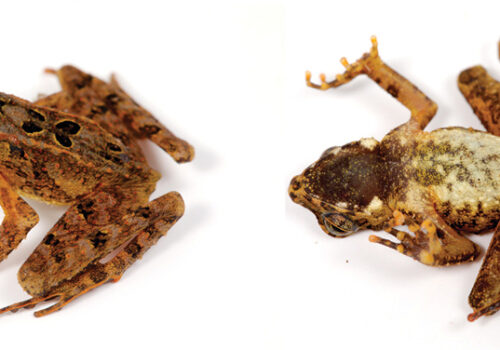
At first glance, Dendrophryniscus cuca might appear humble and inconspicuous, measuring between 20–30 millimeters—a mere thumbnail sized amphibian. Yet close inspection presents a delightful tapestry of textures and colors; its granular, slightly warty skin varies subtly in shades of brown, olive, and gray, interspersed occasionally with darker markings that blend remarkably well within the dappled shadows and decaying vegetation of its habitat.
Physically, its robust yet compact body is finely tuned to its microhabitat. The short, muscular limbs emphasize a lifestyle adapted for slow movements and careful navigation amid leaf litter, moss, and debris, allowing minimal detection by predators. Its feet are equipped with soft pads, useful for gripping onto slippery foliage and uneven substrates on the forest floor.
This remarkable camouflage not only protects the tiny amphibian from predatory birds and snakes but also serves as a stealthy advantage while hunting the smaller invertebrates—tiny beetles, ants, termites, and minute insect larvae—that constitute its primary diet. Such cryptic coloration enables it to ambush prey effortlessly, blending seamlessly into the background and striking with swift efficiency at unsuspecting targets.
Behavior and Life Cycle#
The life cycle of Dendrophryniscus cuca, like much of its biology, remains elusive and somewhat mysterious. Field observations suggest that breeding is closely tied to wet seasons when rainfall rejuvenates streams and temporary pools hidden deep within leafy recesses of its forest home. During these periods, subtle choruses composed of gentle, clicking-like calls emanate from males concealed within leaf-littered habitat—soft serenades seeking to attract receptive females.
Once successful, females deposit small clusters of gelatinous eggs in moisture-laden microhabitats, often concealed under leaves or in slow-moving streams and pools. Unlike many toads, D. cuca produces relatively few eggs, a reproductive strategy differing significantly from larger pond-breeding amphibians. This low reproductive output emphasizes high parental investment within short windows of optimum environmental conditions.
The tadpoles themselves inherit their parents’ cryptic habits, often developing in shallow, shaded pockets of water. Transforming rapidly from swimming larvae into miniature replicas of adults, their metamorphosed forms quickly venture from watery cradles to explore the terrestrial environment.
The Ecological Role of Dendrophryniscus cuca#
Despite their diminutive proportions, forest toads like D. cuca perform critical roles within forest ecosystems. As insectivores, they act as natural pest regulators controlling insect populations, thus maintaining ecological balance. Simultaneously, their presence and health directly reflect environmental quality, earning them the title “indicator species,” as their permeable skin and dependence on intact habitat make them acutely vulnerable to pollutants and climate change impacts.
Moreover, their position within food webs makes them valuable prey resources for various forest predators. Snakes, birds, and small mammals depend on amphibians for food, indirectly tying their survival to these tiny forest inhabitants.
Threats and Conservation Status#
Unfortunately, the story of Dendrophryniscus cuca is intricately interwoven with ongoing threats to the Atlantic Forest—a biome severely reduced by extensive deforestation, agriculture expansion, fragmentation, and urban growth. Currently, the species faces significant pressures due to habitat loss and fragmentation from human development, logging activities, and agricultural encroachment.
While not officially evaluated by the IUCN Red List yet, preliminary evaluations by local authorities indicate significant concern. Deforestation not only degrades their living spaces but also disrupts water availability, alters micro-climatic conditions, and exposes them to environmental contaminants and potential diseases such as chytridiomycosis—a fungal infection which has devastated amphibian populations globally.
Conservation initiatives remain imperative. Efforts to establish protected areas, habitat corridors, and ecosystem monitoring programs are essential. Encouragingly, some local conservation NGOs and research institutions have begun to prioritize amphibian-centered conservation efforts, signaling new hope for safeguarding this enigmatic species.
Cultural and Scientific Significance#
The naming of Dendrophryniscus cuca after “Cuca”—a legendary monster widely known through Brazilian folklore—epitomizes the fascinating cultural allegories linking natural history and human imagination. While the species itself poses no threat, selecting such intriguing names enriches storytelling traditions native to Brazil, fostering deeper public connections and awareness towards amphibian conservation.
Scientifically, species like D. cuca provide invaluable insights into forest ecosystem dynamics, evolutionary biology, and potential biomedical applications. Amphibians’ natural skin secretions often harbor compounds useful in medical research and drug discovery, underscoring real human benefits of healthy ecosystems and intact biodiversity.
Conclusion: A Call to Care#
The story of Dendrophryniscus cuca reveals the intricate balances and complexities underpinning Brazil’s vulnerable Atlantic Rainforest ecosystems. Safeguarding their habitats, supporting sustainable practices, and increasing public awareness form pivotal corners of any effective conservation framework.
As we reflect upon the significance of these tiny forest toads, perhaps it is also an invitation for us to rekindle our innate curiosity towards nature’s lesser-known treasures. By championing their protection, we actively choose to preserve not only this enchanting amphibian but the rich tapestry of life that shapes our living planet.