- Dendrophryniscus berthalutzae: Discovering the Enchanting Beauty of Brazil's Hidden Jewel
- Taxonomy and Classification
- Natural Habitat: Realm of the Leaf Toad
- Physical Characteristics: The Subtle Splendor
- Behavior and Life Cycle: Survival through Ingenious Adaptation
- Ecological Role: Guardians and Indicators
- Threats and Conservation Status
- Cultural and Scientific Significance
- Conclusion: Protecting Nature’s Hidden Treasures
Dendrophryniscus berthalutzae: Discovering the Enchanting Beauty of Brazil’s Hidden Jewel#
Deep within the verdant expanse of Brazil’s Atlantic Forest, among lush foliage and hidden streams, lives a diminutive amphibian whose very existence speaks volumes about the richness—and fragility—of the ecosystem it calls home. The Bertha Lutz leaf toad, scientifically named Dendrophryniscus berthalutzae, is more than simply another colorful jewel hidden in the underbrush. It stands as a testament to evolutionary resilience, the interconnectedness of species, and the ongoing conservation battles safeguarding Brazil’s threatened habitats.
Boasting striking colors and curious behaviors, this tiny frog instantly captivates the imagination of nature enthusiasts fortunate enough to encounter it. Named to honor pioneering Brazilian biologist and women’s rights advocate Bertha Lutz, this diminutive toad reflects the determination and resilience of its famous namesake, hidden yet foundational to understanding and preserving Brazil’s biodiversity.
Taxonomy and Classification#
Dendrophryniscus berthalutzae belongs to the family Bufonidae, more commonly known as true toads. However, this species, within the genus Dendrophryniscus, stands distinctly apart from many other toads whose appearances we traditionally envision. Instead of the familiar bulky and wart-covered creatures often associated with toads, this species is petite and visually strikingly colorful, a brilliant illustration of biological diversity. Its genus encompasses a small group of neotropical leaf toads adapted specifically to humid and pristine rainforest ecosystems.
Closely related species within its genus include Dendrophryniscus minutus and Dendrophryniscus brevipollicatus, both similarly adapted to highly specialized ecological niches in the neotropics. However, detailed genetic studies clearly differentiate Dendrophryniscus berthalutzae in morphological features, geographical range, and behavioral nuances, underscoring the uniqueness of this species.
Natural Habitat: Realm of the Leaf Toad#
The natural sanctuary of Dendrophryniscus berthalutzae is a very specific and increasingly threatened habitat: the ever-mysterious Brazilian Atlantic Forest. Primarily found in Brazil’s Rio de Janeiro and São Paulo states, the species thrives in moist, shaded environments near clear forest streams and rivulets, nestled within these ecosystems’ distinctive foliage-layered microhabitats.
The Atlantic Forest region is widely renowned for its astounding biodiversity and endemism, but tragically, it also stands as one of the world’s most imperiled ecosystems. Lush and dusty moss-covered roots, dense leaf litter, and the constant dripping humidity provide the ideal living conditions. Shaded by towering trees draped in vines and epiphytes, the leaf toad expertly navigates its niche existence. Even small modifications to this delicately balanced habitat—whether by deforestation, pollution, or climate shifts—could threaten the delicate balance essential for its survival.
Immersing oneself in their habitat transports us into a realm where light filters gently through dense tree canopies, shimmering subtly on vivid green ferns, moss-stained boulders, and quiet trickling streams. It’s in this tranquil yet bustling microcosm that Dendrophryniscus berthalutzae thrives, hidden yet essential.
Physical Characteristics: The Subtle Splendor#
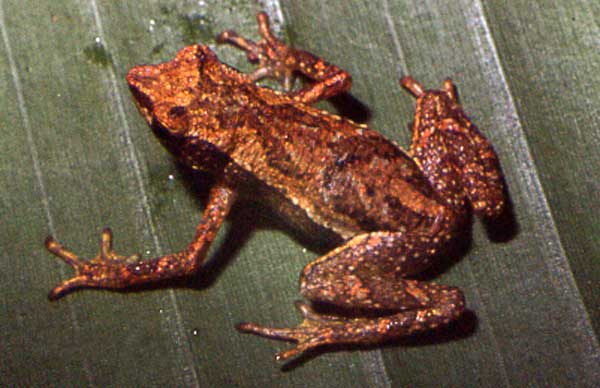
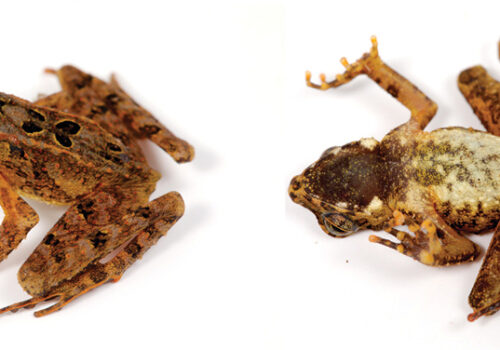
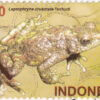
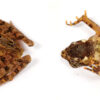
At first glance, the Bertha Lutz leaf toad may appear delicate and almost ornamental. Adults rarely surpass 20 millimeters in length, making them exceptionally small, even compared to other neotropical amphibians. Their small stature, however, does little to diminish their visual allure. Thanks to vibrant coloring, these toads easily rival brighter rainforest spectra, boasting brilliant orange and yellow highlights contrasting vividly against their striking jet-black bodies. These vivid markings are not mere ornamentation—they function as an aposematic coloration, a clear warning to predators about the frog’s toxic capabilities.
The smooth-skinned, somewhat glossy body, along with slender limbs, facilitate agile movement through complex habitat terrain. Their distinctly swollen digits end in expanded toe pads, allowing remarkable gripping abilities upon leaves, twigs, and wet rocks. This feature proves invaluable when navigating the inherently slippery micro-climates of their rainforest homes.
Behavior and Life Cycle: Survival through Ingenious Adaptation#
Feeding Habits and Foraging Techniques#
Despite their tiny size, Bertha Lutz leaf toads play a pivotal role in their ecological community. Opportunistic feeders, their diet primarily consists of diminutive invertebrates like springtails, mites, ants, and other small arthropods abundant within leaf litter and the soil-rich layers of their habitat. Employing a sit-and-wait strategy, these patient predators remain perfectly still, relying on camouflage and stealth before swiftly snapping at their prey in a quick, precise strike.
Reproductive Rituals and Tadpole Development#
Similar to many amphibian counterparts, breeding is triggered by the start of the rainy season, providing ample temporary freshwater habitats. Male leaf toads advertise their presence through soft, melodious calls emitted from hidden perches or dense leaf litter near water source edges. Interestingly, while their vocalizations are not loud, their subtle chorus under dense canopy echoes profusely, creating a captivating acoustic tapestry enveloping their hidden world.
Females lay clusters of small eggs in shallow pools or slow-flowing streams, carefully camouflaged amid leaves and submerged debris. These eggs quickly hatch into tadpoles uniquely adapted to their semi-aquatic conditions, undergoing rapid growth and metamorphosis before transitioning to their terrestrial existence. The young emerge as miniature replicas of their parents, complete with refined hunting instincts ready to navigate their niche space among forest litter.
Ecological Role: Guardians and Indicators#
In nature’s intricate web, each species embodies numerous relationships, interconnected and interdependent. This tiny leaf toad occupies a noteworthy position as both predator and prey. It keeps invertebrate populations balanced, preventing outbreaks that could destabilize the local ecosystem, thus indirectly protecting plants and maintaining forest health.
Moreover, like many amphibians, Dendrophryniscus berthalutzae serves as a valuable bioindicator. Its sensitivity to environmental pollutants, temperature variations, and shifts in humidity means the health of leaf toad populations reflects broader ecosystem health—rendering their health and stability crucial indicators for conservationists monitoring the Atlantic Forest biome.
Threats and Conservation Status#
Despite their ecological importance, Bertha Lutz leaf toads face increasing threats. Habitat degradation through deforestation, urban expansion into formerly undisturbed forest patches, pollution, and escalating climate change impacts pose severe risks to their continued existence. The International Union for Conservation of Nature (IUCN) currently classifies Dendrophryniscus berthalutzae as Near Threatened, recognizing their narrow distribution and high sensitivity to habitat disturbances. This urgency underscores conservationists’ calls for action to preserve critical Atlantic Forest fragments and manage sustainable interactions within these regions.
Current conservation priorities involve protecting their natural habitat through establishing protected areas, strengthening forest corridors, and advocating for local communities’ involvement in sustainable land use practices and eco-tourism initiatives. Conservationists actively engage local communities, recognizing that sustainable coexistence—not exclusion—is key to ensuring this tiny toad’s survival.
Cultural and Scientific Significance#
Naming this delicate species after scientist and feminist activist Bertha Lutz highlights its unique symbolic significance, emphasizing the historical importance of women in Brazilian science and conservation communities. Bertha Lutz herself famously championed biodiversity preservation and women’s involvement in scientific endeavors. The naming serves as an enduring testament to her significant contributions, simultaneously elevating this species to symbolic cultural status.
Moreover, studying these toads’ ecological and physiological adaptations yields invaluable data. Their skin secretions, for instance, may hold future scientific clues, potentially contributing to pharmaceutical research involving antimicrobial compounds or other bioactive substances yet undiscovered.
Conclusion: Protecting Nature’s Hidden Treasures#
Dendrophryniscus berthalutzae, modest in stature yet resplendent in coloration and ecological value, embodies the intricate beauty, complexity, and fragility inherent within Brazil’s precious and endangered Atlantic Forest. By protecting this diminutive toad, we not only safeguard an animal uniquely suited for its jungle living but, significantly, shield countless other deserving, interlinked species.
Let’s embrace this species as a flagship, illuminating the need for greater appreciation, education, and conservation initiatives. Supporting habitat restoration projects, engaging in local community advocacy, and raising awareness can collectively ensure the lasting legacy of the mesmerizing Bertha Lutz leaf toad contained within Brazil’s lush foliage. Let us come together, inspired by nature’s intricate jewels, to preserve this priceless tapestry for future generations.