- Churamiti Maridadi: Discovering the Enchanting Jewel of East Africa's Forests
- Taxonomy and Classification
- Natural Habitat and Range
- Anatomy and Appearance: Artistry in Miniature
- Life Cycle and Behavior: Secrets Beneath the Leaf Litter
- The Ecological Symphony: Churamiti's Role in its Ecosystem
- Facing an Uncertain Future: Threats and Conservation Efforts
- Cultural Significance and Scientific Discovery
- Appreciating the Jewel of Tanzania: A Call to Action
Churamiti Maridadi: Discovering the Enchanting Jewel of East Africa’s Forests#
The dense mist lifts slowly from the canopy, unveiling a lost kingdom of emerald foliage, vibrant color, and hidden wonders. Deep in the heart of East Africa’s lush forests dwells a creature so subtly elegant and rare that it often eludes even the keenest naturalist’s eye—the Churamiti maridadi. Known fondly among herpetologists and conservationists for its striking beauty and mysterious habits, this tiny frog species exemplifies nature’s artistry and biodiversity at its finest. The name itself, “maridadi,” derived from Swahili, fittingly means “beautiful,” underscoring the immediate charm this amphibian bestows upon every observer lucky enough to catch a glimpse.
First formally described in the early 2000s, Churamiti maridadi has since captivated biologists, conservationists, and nature enthusiasts alike, drawing their curiosity deeper into its enigmatic life. Despite its charming appearance and colorful presence, the maridadi frog remains relatively unknown to the wider world—a hidden gem tucked away beneath leaf litter, quietly sustaining the delicate ecological web of its forest home.
Taxonomy and Classification#
Belonging to the diverse family Microhylidae, Churamiti maridadi is a notable representative of the order Anura, commonly known as frogs and toads. The genus Churamiti itself is relatively young, with maridadi a sole representative thus far—a single rare species embodying an entire genus and reminding us just how vast and unexplored amphibian diversity remains.
Venancio Ngalason and his colleagues first identified and named this frog, inspired by its remarkable combination of ornate patterns and stunning coloration. Close relatives at the family level include diminutive microhylid frogs dwelling particularly in subtropical and tropical zones, but none share the distinctiveness and charisma of Churamiti’s maridadi.
Natural Habitat and Range#
To find Churamiti maridadi, one must venture into the biologically rich forests of Tanzania’s Udzungwa Mountains—a biodiversity hotspot unsurpassed for its wealth of endemic life. Within Tanzania’s southern highlands lies an intricate mosaic of lush evergreen forests and mist-enshrouded montane habitats, prime territory for this remarkable amphibian.
Unlike many amphibian species found along forest streams or ponds, the maridadi flourishes within the dense leaf litter of the forest floor, beneath the shadowy cover of towering canopy trees. It thrives in specific microhabitats characterized by high humidity, consistent warmth, and scattered fallen leaves and debris—including rotting logs and decaying plant matter—as these environmental niches provide essential moisture, concealment, and abundant insect prey.
This specificity of habitat underscores both the fragility and resilience inherent in Churamiti maridadi’s ecology. The stability and health of the forest ecosystem directly affect the thriving ability of this unique amphibian, reinforcing the interconnectedness fundamental to conservational concerns.
Anatomy and Appearance: Artistry in Miniature#
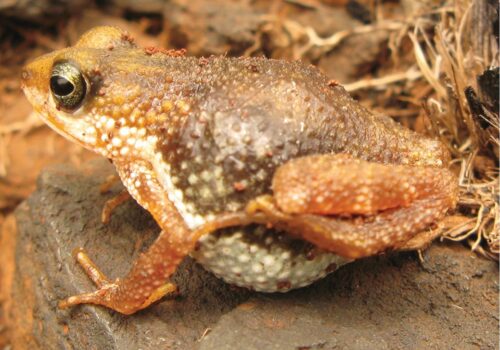
Precisely measuring no longer than two centimeters in body length, the Churamiti maridadi exemplifies remarkable evolutionary specialization tailored to life amidst leaves and shadow. Its tiny stature allows effortless navigation among layers of forest floor vegetation, traversing quietly as it hunts for its insect prey—or tactfully eludes predators.
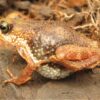
Yet the maridadi’s small size belies the stunning complexity of its appearance. Each frog wears a breathtaking cloak of greens, golds, browns, and subtle blues—an elegant mix similar to an elaborate artisanal painting. The striking combination of colors provides near-perfect camouflage against the dappled sunlight and varied tones of the forest floor. Melodic patterns ripple gracefully along its back and limbs, often punctuated by tiny spots or streaks of vibrant gold reminiscent of intricate Tanzanian beadwork.
Its skin, moist and smooth, is deceptively delicate, playing a vital role in respiration and thermoregulation. The large round eyes, black as polished obsidian beads, protrude slightly upward, capturing ambient light and movement in the dim underbrush and aiding its effective yet cautious lifestyle.
Life Cycle and Behavior: Secrets Beneath the Leaf Litter#
Masters of Subtlety: Hunting and Feeding#
Churamiti maridadi holds court beneath the detritus of fallen leaves, patiently waiting to spring invisible traps upon unsuspecting ants, mites, termites, and small beetles. Its feeding technique is precise and swift—launching its small, sticky tongue to capture prey within milliseconds, leaving the forest floor seemingly untouched by disturbance.
Quiet Serenades: Courtship and Breeding Behavior#
When the rainy season arrives and the forest air hums with renewal, these silent predators ascend briefly from their hidden refuges to participate in nature’s ancient ritual of courtship. Male maridadis emit calls so gentle and subdued they are often mistaken for sounds of dripping water or rustling leaves. This sonic subtlety protects the frog from unwanted attention as it pursues essential reproductive tasks within the secretive world of nighttime forest activities.
Mating occurs discretely beneath layers of decomposing vegetation, where the eggs are carefully deposited away from view. Eggs undergo development into minute tadpoles within hidden, moisture-rich pockets in the leaf mold. Free of aquatic environments required by most amphibians, the young develop quietly and privately—a fascinating evolutionary adaptation allowing successful survival away from predator-rich waters. After metamorphosis, the juvenile frogs emerge fully formed, miniature replicas of their parents and perfectly suited to life under leaf cover.
The Ecological Symphony: Churamiti’s Role in its Ecosystem#
As relentless yet unobtrusive predators of tiny arthropods, Churamiti maridadi frogs play vital roles in controlling insect populations within their territory. By influencing the numbers of insects and mites, they indirectly affect plant health and soil nutrient cycles—fulfilling essential ecosystem services within the forest floor micro-community.
Furthermore, the frogs themselves serve as important prey for numerous predators like small mammals, snakes, lizards, and birds, forming a crucial link in the complex food web supporting larger organisms. Therefore, their presence not only ensures biodiverse stability at the foundational level but also points toward healthy forest conditions, benefiting an entire ecosystem network dependent on this finely tuned ecological harmony.
Facing an Uncertain Future: Threats and Conservation Efforts#
Despite their secretive lifestyles, Churamiti maridadi frogs are gradually succumbing to the pressures of environmental degradation. Habitat loss, due largely to deforestation and expanded agriculture, forest fragmentation, and human settlement, poses severe threats. Their reliance on highly specific microhabitats makes recovery challenging wherever these delicate niches become disrupted or destroyed.
Climate variation and extreme weather patterns associated with global warming also jeopardize their future prospects, rendering previously stable habitats unpredictable and possibly unsuitable. As amphibians maintain permeable skin, they remain exceedingly vulnerable to pollution, diseases such as chytrid fungus (a devastating threat to amphibians worldwide), and other ecological stressors.
Though not yet officially assessed for the International Union for Conservation of Nature (IUCN), preliminary analyses suggest that the population could be highly susceptible to rapid decline without interventions. Conservation teams, recognizing the urgent threat faced by this fascinating species, advocate for intensified field studies, habitat protection measures, boundary creation for protected forest areas, and comprehensive education campaigns involving local communities invested in securing ecological integrity.
Cultural Significance and Scientific Discovery#
In the local beliefs of Tanzanian communities living near the Udzungwa Mountains, frogs symbolize renewal and resilience, mirroring their annual appearance with the rains. Although the specific species itself may not feature prominently in folklore due to its elusive nature, its discovery represents a testament to the hidden biological richness of Tanzanian forests, eroding barriers between science, conservation, and local appreciation for biodiversity.
Scientifically, the maridadi’s adaptation to terrestrial breeding and development presents evolutionary characteristics of substantial interest to researchers exploring amphibian adaptation, survival under climate stress, and novel ecological interactions—a biological lesson still unfolding in secluded Tanzanian wilderness.
Appreciating the Jewel of Tanzania: A Call to Action#
The Churamiti maridadi is not only a visually arresting amphibian—it symbolizes the rich yet fragile balance maintained within delicate ecosystems like Tanzania’s Udzungwa Mountains forests. Our understanding and protection of this enigmatic frog contribute to broader conservation efforts critical for safeguarding biodiversity worldwide.
We invite you, fellow nature enthusiasts, students, and conservation champions, to step into advocacy for amphibians’ silent worlds. By supporting conservation organizations and sustainable practices in critical habitats, we stand a chance of preserving treasures like Churamiti maridadi for generations ahead. May its hidden beauty continue inspiring wonder, respect, and awe long into the future.