- Bufotes Balearicus: Exploring the Enigmatic Balearic Green Toad
- Taxonomy and Classification of Bufotes balearicus
- Natural Habitat: Islands of the Mediterranean
- Vivid Physical Characteristics of the Balearic Green Toad
- Behavior and Life Cycle: Nightly Serenades and Seasonal Strategies
- Ecological Role: Guardians of Mediterranean Balance
- Threats and Conservation of the Balearic Green Toad
- Cultural Significance and Scientific Discovery
- Conclusion: Protecting a Mediterranean Jewel
Bufotes Balearicus: Exploring the Enigmatic Balearic Green Toad#
Tucked away in the captivating islands and coastal regions of the Mediterranean, a small amphibian with a vivid charm quietly lives and thrives. Bufotes balearicus, commonly known as the Balearic Green Toad, is a fascinating amphibian species that tells a story of adaptation, survival, and delicate ecological balance. From its subtle calls echoing at twilight to its exquisitely camouflaged body against lush vegetation and rocky terrain, this species enchants those lucky enough to discover its secretive life. But beyond simple fascination, the Balearic Green Toad fulfills a crucial ecological role within its delicate island ecosystems, meriting deeper exploration and conservation attention.
Join us on an immersive journey to uncover the complex world of Bufotes balearicus, a species that weaves intricate connections between the habitats it inhabits, the species with whom it interacts, and the human communities that impact its continued existence.
Taxonomy and Classification of Bufotes balearicus#
The systematic classification of the Balearic Green Toad has undergone considerable refinement over the decades. Formerly grouped with other green toads under the larger Bufo viridis species complex, genetic studies and morphological investigations have since illuminated its unique identity. Today, it lives under the genus Bufotes, within the family Bufonidae, reflecting its evolutionary differences from its cousins. Thus, its proper scientific nomenclature reads as Bufotes balearicus.
This distinction helped clarify long-standing uncertainties about the distribution and biology of Mediterranean toads. Closely related species within this genus, such as Bufotes viridis (the European Green Toad) and Bufotes boulengeri, share traits and ecological niches; yet, the Balearic Green Toad stands apart due to its limited and geographically isolated distribution.
Natural Habitat: Islands of the Mediterranean#
If you wander along the shores or traverse inland landscapes of the Mediterranean islands and coastal territories such as the Balearic Islands (Mallorca, Menorca, Ibiza), parts of Corsica, Sardinia, and mainland Italy, you might closely pass this amphibious marvel without even noticing. Although present, the Balearic Green Toad possesses an ingeniously efficient camouflage strategy, its spotted patterns blending seamlessly with moist earth, lichens, moss-covered stones, and verdant vegetation.
Inhabiting primarily temperate climates within Mediterranean woodlands, scrubland, open agricultural fields, and even suburban gardens, this adaptable creature thrives around freshwater environments, such as temporary puddles, ponds, streams, and irrigation canals. A master of utilizing temporary water resources, the toad takes advantage of seasonal rainfall to spawn, highlighting its ability to persist even in the unpredictable Mediterranean climate.
Adaptation to these habitats extends beyond mere physical camouflage, allowing Bufotes balearicus to brilliantly navigate the challenges posed by tourism developments, agricultural landscapes, and shifting weather patterns.
Vivid Physical Characteristics of the Balearic Green Toad#
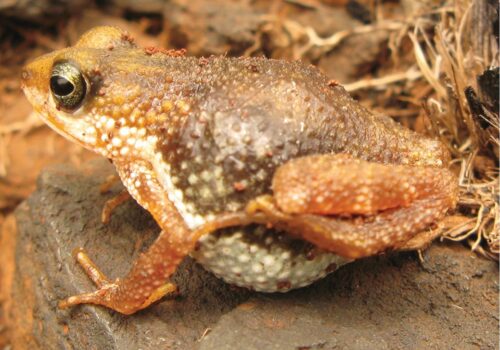
Bufotes balearicus is visually captivating, an appealing mosaic of greens, browns, and grays across its body. Adults typically measure around 6 to 9 centimeters, exhibiting robust yet relatively small physiques. The coloration of individual toads can vary significantly, adapting itself dynamically to match local terrain and vegetation. Under daylight scrutiny, intricate blotches and spots emerge in varying shades of olive green, punctuated by mottled dark spots bordered by lighter creams or peach-colored outlines.
Perhaps most intriguing is the subtle yet tangible variation in coloration and pattern even within short distances, a testament to how meticulously evolution has sculpted these amphibians for perfect concealment. Their skin texture, warty and distinctly rough to human touch, serves not only as a further layer of camouflage but also as a defensive adaptation, deterring potential predators from an unappetizing meal.
Eyes large and gold-amber to copper in tone provide impressive nocturnal vision, enabling an effective nocturnal hunt for their insect prey. Their short, powerful hind legs reflect their predominantly terrestrial lifestyle, favoring short, efficient hopping over longer leaps typically associated with frogs.
Behavior and Life Cycle: Nightly Serenades and Seasonal Strategies#
As dusk descends upon the Mediterranean countryside, gardens, and streamsides, the gentle yet persistent chirping call of the Balearic Green Toad fills the twilight air—a harmonious blend of trills and croaks. Males congregate near temporary pools or humid lowlands to call persistently, advertising their availability to potential mates.
The breeding strategy of Bufotes balearicus is a finely tuned ecological dance, carefully adapted to the Mediterranean climate. Many of their spawning sites are ephemeral pools, ponds, or shallow streams formed during seasonal rains. After laying eggs in gelatinous strings, the breeding pair disperses, engaging in minimal, if any, parental care—a common trait among toad species that relies heavily on environmental cues for reproductive success.
Larvae, known as tadpoles, quickly hatch and must develop efficiently, expediting their transformation to terrestrial adults within weeks to escape pools’ eventual drying. Such rapid developmental strategies have evolved uniquely to cope with unpredictable freshwater availability in Mediterranean habitats.
Ecological Role: Guardians of Mediterranean Balance#
While modest in stature, Bufotes balearicus significantly influences its ecosystem’s overall health and stability. As prolific insectivories, each adult toad voraciously consumes a wide range of insects and other small invertebrates, keeping populations of agricultural pests in check. Consequently, this reduces the need for chemical insecticides in nearby farms and gardens, benefiting both biodiversity and human communities.
The Balearic Green Toad, conversely, serves as a valuable food source for a variety of predators. Birds, snakes, small mammals, and other amphibians readily prey upon these toads, integrating them seamlessly into the food web.
Moreover, as an amphibian sensitive to environmental changes, the presence and stability of its populations offer reliable clues about the ecological integrity and health of their habitats. Thus, ecologists regard these toads as valuable bioindicators—crucial sentinels alerting humans to potential environmental threats.
Threats and Conservation of the Balearic Green Toad#
Unfortunately, despite this species’ ecological importance and remarkable adaptability, Bufotes balearicus faces numerous threats. Habitat degradation poses a severe challenge, primarily driven by increasing urban development, agriculture intensification, the construction of tourist facilities, and infrastructure expansion, all severely altering and fragmenting crucial habitats.
Additionally, climate change exacerbates threats by increasing drought frequency, reducing freshwater availability crucial for successful breeding and survival. Pollution from agricultural run-off, pesticides, and contaminants further endangers these amphibians, potentially impairing their reproductive health and survival rates.
Today, the International Union for Conservation of Nature (IUCN) categorizes Bufotes balearicus as “Least Concern,” but with steadily declining local populations, scientists and conservationists caution vigilance. Conservation measures focusing on habitat preservation, restoration of temporary breeding pools, and sustainable agricultural practices are critical in safeguarding this remarkable species’ future.
Cultural Significance and Scientific Discovery#
In Mediterranean folklore, amphibians often feature prominently as symbols of renewal and the cyclic nature of life, signifying transition, change, transformation, and rebirth—a fitting role given their complex life cycle from aquatic larvae to terrestrial adults.
Scientifically, the Balearic Green Toad has contributed significantly to research concerning species’ responses to climate change, allowing studies into developmental flexibility, rapid growth rates, and behavioral adaptations under environmental pressures. Its unique adaptations have become touchstones for understanding amphibian resilience and vulnerability worldwide.
Conclusion: Protecting a Mediterranean Jewel#
In the twilight choruses echoing across the Mediterranean’s serene landscapes lies a powerful reminder of how interconnected and fragile our ecosystems truly are. Bufotes balearicus, the Balearic Green Toad, embodies the delicate but resilient thread binding species, habitats, and humans in shared ecological destinations.
As citizens, nature lovers, researchers, and adventurers, our responsibility becomes clear. Together, we must advocate for the protection of this little green ambassador of Mediterranean biodiversity. After all, preserving the rich tapestry of life on our planet often starts with appreciating and safeguarding even the subtlest of chirping voices echoing into the night.
Explore, appreciate, and help conserve—because every creature matters, from the mightiest mammals to the smallest, camouflaged amphibian hidden in the dusky Mediterranean twilight.