Atelopus Exiguus: Exploring Ecuador’s Enchanting Harlequin Frog#
In the lush cloud forests of Ecuador, nestled among damp ferns and moss-covered rocks, a tiny frog holds an oversized ecological and cultural significance. Meet the Atelopus exiguus, commonly known as the Mazán jambato or the dwarf harlequin frog—a species whose very existence whispers stories of resilience, fragility, and ecological balance. Small enough to fit snugly upon a human fingertip, Atelopus exiguus leads a quiet yet captivating life, intricately woven into the fabric of its rainforest home.
Few amphibians have captured the imagination of naturalists, scientists, and conservationists quite like this minuscule member of the Bufonidae family. Vibrant, mysterious, and increasingly rare, the dwarf harlequin frog has become both a symbol of Ecuador’s biodiversity and a striking reminder of what is at stake if we fail to protect our planet’s fragile ecosystems.
Before we begin our exploration of this remarkable species, consider this: although measuring a scant two centimeters at its largest, Atelopus exiguus has evolved unique adaptations—bright colors that warn predators of their potent toxins, behaviors tailored to the moist high-altitude habitats, and fascinating reproductive patterns that reflect countless millennia of evolution at work. Small though they may be, these frogs have a story to tell—a story of survival that deserves to be heard.
Taxonomy and Classification#
First scientifically described in 1973 by eminent herpetologists Lynch and Duellman, Atelopus exiguus belongs firmly within the Amphibia class. It falls under the Anura order—frogs and toads—and resides within the Bufonidae family, home to true toads and related species. Within this diverse family, Atelopus represents a genus of strikingly colorful frogs collectively known as “harlequin toads.” These amphibians are celebrated for their vibrant coloration and their significant roles as environmental indicators.
Within this group, A. exiguus is closely related to numerous other harlequin toads, such as Atelopus varius, another critically endangered Andean guide whose plight mirrors that of our subject species. Scientists often study these closely related species together to better understand complex ecological interactions and conservation requirements across shared mountain habitats.
Natural Habitat#
Geographic Range: A Jewel of the Ecuadorian Andes#
Atelopus exiguus resides exclusively within Ecuador’s distinctive high-altitude cloud forests and paramos, located along the country’s western Andean slopes. Its native range spans elevations between approximately 2,700 and 4,000 meters above sea level, particularly documented within regions such as Cotopaxi, Bolívar, and Chimborazo provinces.
These ecosystems are nothing short of magical—cloud forests perpetually cloaked in mist, cloistered by twisted trees adorned with hanging mosses and lichens. Swift mountain streams tumble down steep gorges, their crystal-clear waters home to delicate ecosystems that thrive between sunshine and shadow, warmth and chill.
Habitat Preferences: Life Amid Mist and Moss#
The dwarf harlequin frog has evolved to perfectly fit these atmospheric forests. Preferring the moist environments along streams and in humid valleys, Atelopus exiguus spends much of its time hidden among leaf litter or tucked beside damp rocks, awaiting unsuspecting insect prey or gently soaking up moisture through its skin—a critical process in amphibian survival.
Humidity and temperature stability are critical; even subtle alterations to its microhabitat can spell disaster for this sensitive species. Through adaptations honed by centuries in these precise habitats, Atelopus exiguus exemplifies how finely balanced amphibians can be within their chosen ecological niches.
Physical Characteristics#
Small in Stature, Brilliant in Appearance#
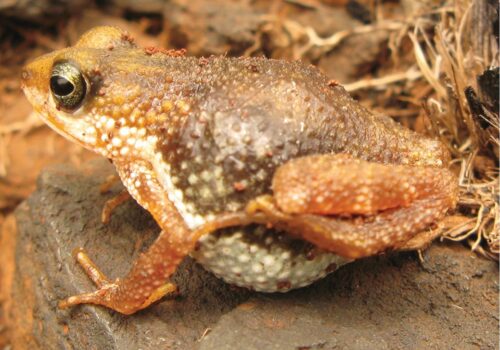
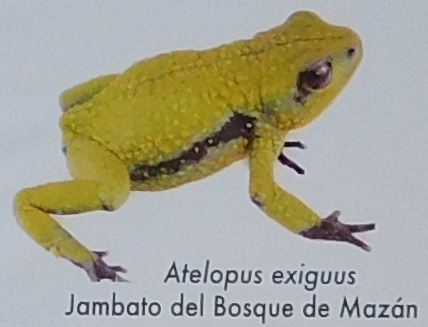
Don’t let their tiny size fool you—Atelopus exiguus packs a powerful aesthetic and ecological punch. Rarely exceeding two centimeters in length, adults exhibit slender yet robust bodies, complete with elongated limbs adapted for climbing along the banks of mountain streams. Their smooth skin, mildly textured across the back, aids both camouflage and moisture absorption.
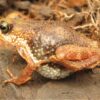
But the colorations steal the show: the dwarf harlequin frog displays vibrant hues ranging from brilliant yellows to deep blacks, frequently adorned with intricate patterns including stripes, bands, and spots. Each individual’s markings are slightly unique, like fingerprints, allowing researchers to identify and study populations closely.
Defense Through Vibrant Markings#
The colorful display is far from vanity; it’s a crucial survival adaptation known as aposematic coloration—visual warning signs of danger to would-be predators. Skin secretions containing potent toxins derived from alkaloid compounds deter birds and other animals, effectively communicating the frog’s unpalatability.
These toxins have also garnered much scientific interest, holding promise for medical research into painkillers, antimicrobial agents, and potentially life-saving drugs.
Behavior and Life Cycle#
A Diet of Small Prey and Hidden Hunters#
Atelopus exiguus, like many amphibians, is an insectivore primarily. Feeding by ambush, these frogs patiently stalk small insects—ants, beetles, flies, and mites—that scuttle along the forest floor or over moist vegetation. Sharp eyesight and swift reflexes enable this species to make efficient, rapid strikes on prey items, bolstering their nutritional and energetic needs.
Reproductive Rituals: Mating Calls and Mountain Streams#
The breeding season of Atelopus exiguus typically coincides with rainy periods, when streams swell with fresh rains, creating optimal conditions for egg-laying and tadpole development. Male frogs venture boldly to strategic perches near rushing waters, emitting soft, rhythmic chirps and buzz-like mating calls—songs of attraction meant to draw females toward prime breeding sites.
Females carefully select breeding partner and egg deposition locations, adhering gelatinous strands of dozens of small dark eggs beneath streamside rocks or submerged vegetation. Here, in the relative safety of flowing waters, eggs hatch into tadpoles specially adapted to cling to rocks amid powerful currents, their sucker-like oral discs anchoring securely to the substrate as they feed on algae and microorganisms.
This precision-driven strategy exemplifies the species’ immaculate adaptation to its mountainous habitat, yet also renders it vulnerable, as any change in water quality or flow can jeopardize entire breeding cycles.
Ecological Role#
Despite—or perhaps precisely because of—their minuscule size, Atelopus exiguus frogs play disproportionately large roles within their ecosystems. As both hunters and hunted, they form important ecological links between insect populations and higher-level predators such as snakes, birds, and small mammals. By regulating invertebrate numbers, these little frogs help maintain balance, indirectly protecting plant health and aiding in decomposition processes vital to forest health.
The dwarf harlequin frog also acts as an important ecological indicator, their sensitivity to environmental changes—water purity, humidity, temperature fluctuations—providing early warnings for broader ecosystem distress that might otherwise go unnoticed.
Threats and Conservation Status#
A Species on the Brink#
Unfortunately, like many other Atelopus species, A. exiguus faces severe threats from multiple directions. Currently listed by the IUCN Red List as “Critically Endangered,” this Ecuadorian endemic amphibian suffers mainly due to habitat loss caused by agricultural expansion, logging, mining activities, and infrastructure projects.
Additionally, amphibian populations globally—including Atelopus exiguus—are critically threatened by chytridiomycosis, a fungal disease caused by the chytrid fungus (Batrachochytrium dendrobatidis). This pathogen has devastated amphibians on several continents and poses an existential risk to the dwarf harlequin frog.
Conservation in Action#
Thankfully, robust conservation initiatives are underway, aimed at protecting remaining habitats, monitoring populations, and establishing captive breeding programs. Collaboration among Ecuadorian government agencies, conservation NGOs, local communities, and international scientists offers hope for the Mazán jambato.
Cultural and Scientific Significance#
In local culture and scientific circles alike, Atelopus exiguus symbolizes the paramount importance of biodiversity and the urgency of environmental conservation. Its struggles spotlight the broader issues surrounding habitat preservation, climate change, and biodiversity loss.
Conclusion#
Atelopus exiguus—Ecuador’s precious dwarf harlequin frog—serves as both a fascinating creature worthy of admiration and a powerful emblem of Earth’s environmental fragility. Each step we take to recognize, appreciate, and conserve these tiny amphibians is a stride toward safeguarding our planet’s biodiversity.
Let the story of Atelopus exiguus inspire action; support conservation initiatives, become advocates for amphibians everywhere, and commit to protecting the delicate balance of life on Earth—one beautiful, vibrant frog at a time.