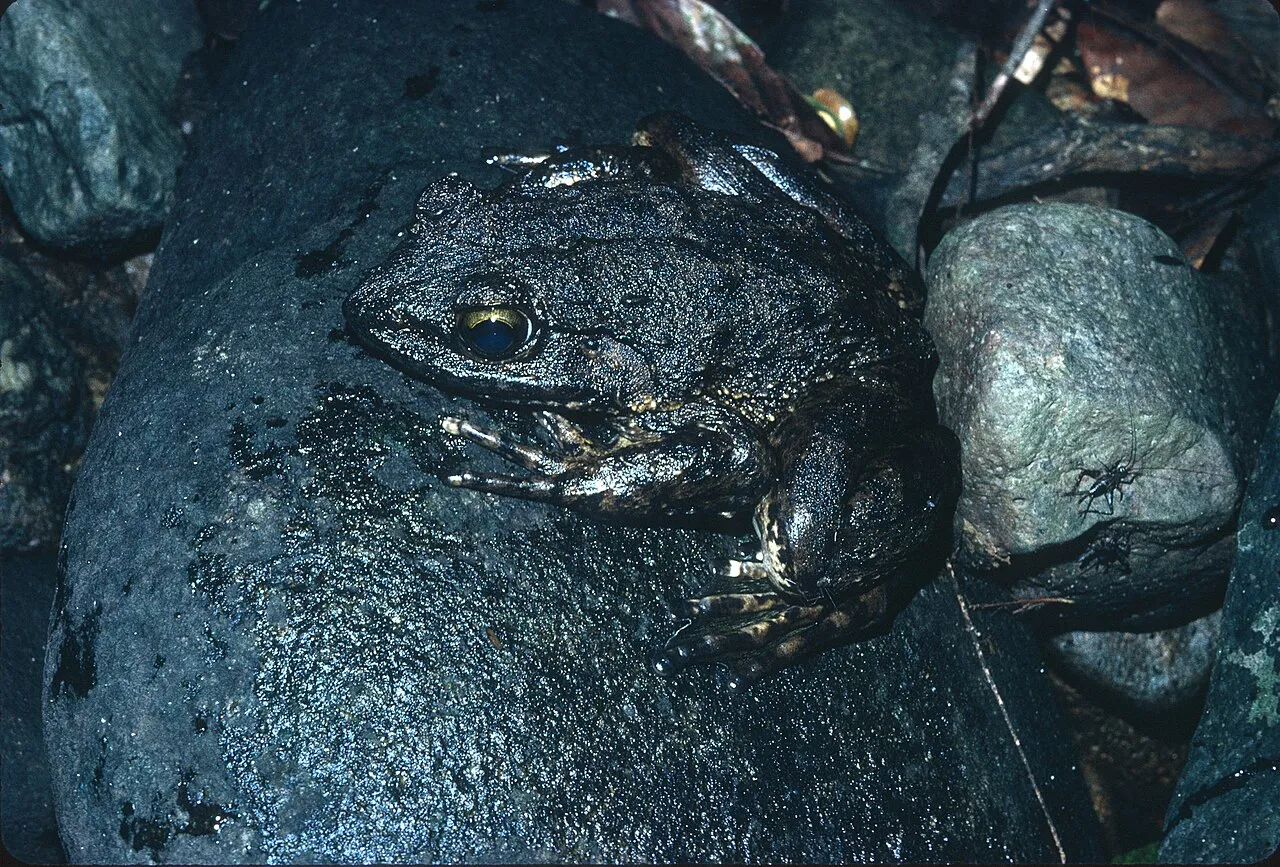
The Goliath frog, Conraua goliath, holds a title no other living frog can claim: the largest frog species on Earth, with adults reaching a body length of 170–320 mm and a weight of up to 3.25 kg. It lives out that record entirely within a narrow strip of West African rainforest, tied to the same fast-flowing rivers it needs to breed, and it defends itself with little more than camouflage — humans are its only significant predator. That vulnerability, layered on top of a shrinking range, is why the species is now classed as Endangered.
Identification
Size alone sets C. goliath apart from every other frog: the facts box carries the full range, from 170 mm juveniles-turned-adults to 320 mm giants weighing up to 3,250 g. Beyond bulk, it has a flattened, wide body and a triangular head, with greenish-brown colouring above and a yellowish-green underside, granular skin on its back that helps it blend into wet, moss-covered rocks, and feet that are extensively webbed on both the front and hind limbs. Its front legs are short and stout, while its hind legs are long, built for the powerful leaps and swimming strokes its river habitat demands. Its eyes are unusually large for a frog, at nearly 2.5 cm across.
Habitat and range
The species is restricted to a narrow coastal band of equatorial rainforest in Cameroon and Equatorial Guinea, in West Africa. Within that range it keeps to fast-flowing rivers and waterfalls inside dense, humid, relatively warm forest, where the water typically sits around 67°F (about 19°C) and stays clean, oxygen-rich and slightly acidic — conditions it cannot easily find outside this one stretch of coastline. That dependence on fast, well-oxygenated water is also what confines the species so tightly: it is rarely if ever found away from the rivers and waterfalls that meet those conditions.
Behaviour and breeding
Adults are carnivorous and mostly nocturnal, hunting along riverbanks after dark for insects, crustaceans, fish, molluscs, and even small mammals and amphibians; younger frogs stay submerged, while older individuals will bask on rocks in the open. That diet puts the species in the middle of the river food web: as adults it has few natural predators beyond people, but juveniles are taken by birds, reptiles and other mammals. It is a largely quiet animal outside the breeding season — lacking vocal sacs, it relies mostly on visual and tactile cues rather than calls, and how long individuals live is not well documented, though wild frogs appear to survive longer than those kept in captivity. Courtship is the exception: rather than inflating vocal sacs, males hold their mouths open to produce a long whistling call to attract females, and a female may mate with more than one male in a season. Fertilisation happens outside the body — a female lays several hundred eggs at a time, each about 3.5 mm across, which stick to river vegetation. The tadpoles that hatch are vegetarian, feeding exclusively on the aquatic plant Dicraea warmingii, which itself grows only near the waterfalls and rapids the species depends on, and take 75 to 90 days to reach roughly 5 cm before metamorphosing into froglets.
Conservation
The species’ facts box carries its current IUCN Red List category, Endangered. That listing reflects a documented decline of about 50% in population size over the last three generations, driven by hunting for food, forest habitat loss from human settlement, sedimentation, commercial logging, agriculture and capture for the international pet and zoo trade. Some protection exists in national parks and sanctuaries across its range, and Equatorial Guinea caps legal exports at 300 frogs a year. Beyond the pet and zoo trade, wild-caught individuals are also exported abroad for frog racing and eaten locally as a food source, demand that compounds the pressure already put on the species by habitat loss.
Similar species
Because of its extreme size, adult C. goliath is not easily mistaken for any other frog within its range; no other West African species approaches its body length or weight. Juveniles are closer in size to other large riverine frogs sharing the same fast-flowing habitat, where the combination of granular, moss-toned skin and heavily webbed feet remains the clearest field mark to confirm an identification.