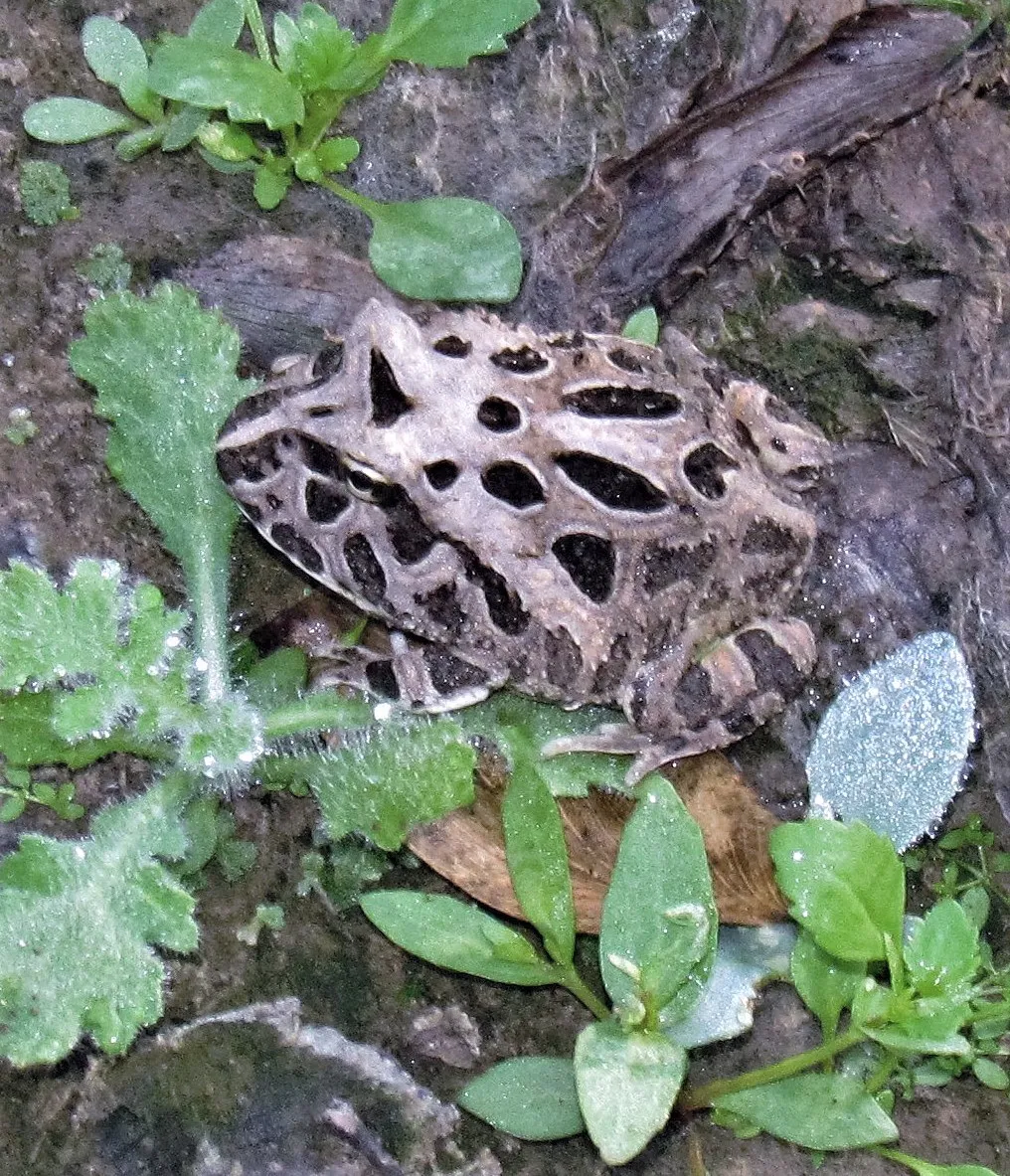
Ceratophrys cranwelli, Cranwell’s horned frog, is a stout, wide-mouthed amphibian of the family Ceratophryidae, endemic to the dry Gran Chaco region of Argentina, Bolivia, Paraguay and Brazil. It belongs to a genus nicknamed “Pacman frogs” for their rounded bodies and oversized mouths, and spends most of its life sitting still, half-buried in the ground, waiting for prey to come within range.
Identification
Adults typically reach 80–130 mm in length and can weigh up to 0.5 kg, making it one of the larger and heavier frogs of its range. Like other horned frogs, it has a disproportionately wide mouth and a squat, rounded body built for ambush rather than movement. Its coloration varies between individuals but generally produces a mottled pattern that blends in with the dry leaf litter and soil of the Chaco, as shown in the photograph above.
Habitat and range
Cranwell’s horned frog is restricted to the dry Gran Chaco region spanning Argentina, Bolivia, Paraguay and Brazil, a vast lowland plain of thorn forest and scrub that is considerably drier than the rainforest habitats favoured by many other Neotropical frogs. Within this range, it inhabits dry, terrestrial environments rather than the streams, ponds or wet forest floor used by many of its relatives.
Behaviour and breeding
The species is nocturnal and largely sedentary, often resting half-buried with its eyes open, conserving energy by staying motionless for long stretches. Despite this inactivity, it is an aggressive ambush predator, able to leap several body lengths to seize prey, striking suddenly from its buried position rather than pursuing food across open ground. It feeds on insects and similarly sized animals including rodents and other frogs, sometimes attempting prey nearly its own size, a reach made possible by that oversized mouth.
Conservation
Ceratophrys cranwelli is classed as Least Concern, as shown in the facts box above. Its wide distribution across the Gran Chaco of Argentina, Bolivia, Paraguay and Brazil, together with its tolerance of a harsh, dry habitat that limits competition from more water-dependent frogs, means the species faces no immediate conservation concern across most of its range.
Similar species
Cranwell’s horned frog belongs to a genus of several similar-looking “Pacman frogs,” and its wide mouth, rounded body and mottled, leaf-litter coloration are shared traits across Ceratophrys. Within its own range in the Gran Chaco, its combination of large size, strictly terrestrial and nocturnal habits, and sit-and-wait hunting strategy helps distinguish it from the region’s more active, water-associated frogs.