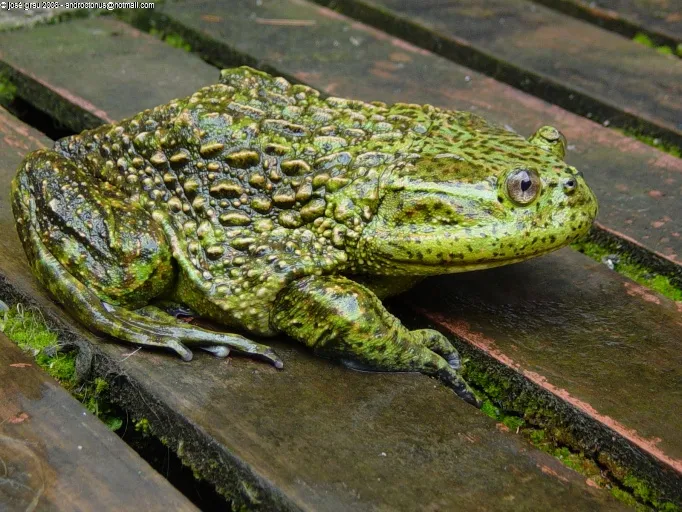
Calyptocephalella gayi, also known as the helmeted water toad or Chilean helmeted bull frog, is a large, heavy-bodied amphibian and the sole living member of the family Calyptocephalellidae. It lives in central Chile, in deep ponds and reservoirs, with a possible additional presence in adjacent west-central Argentina.
Identification
This is one of the largest frogs in the Americas: snout-vent length reaches up to 155 mm in males and up to 320 mm in females, with females growing markedly bigger than males. Typical adult weight runs 0.5–1 kg, with exceptional individuals reaching 3 kg, far heavier than any other frog native to Chile. It is a robust species with a broad head and a large mouth, and colouring runs from yellow, brown and green in younger animals to light green in mature specimens, with the oldest individuals turning grey or developing grey patches.
Habitat and range
Calyptocephalella gayi is aquatic to semi-aquatic, living in deep ponds and reservoirs rather than the shallow, vegetated margins favoured by many smaller frogs. Its tadpoles have more particular needs: they require vegetated, seasonal ponds with some drainage to complete development, and prefer the cooler, vegetated areas of the water body. That split — permanent deep water for adults, seasonal vegetated shallows for larvae — ties the species to a fairly narrow set of wetlands across its central Chilean range. Temperature matters too: mortality rises at water temperatures around 25°C, and the species cannot survive temperatures of about 30°C or higher, which leaves it exposed as droughts and climate change warm and shrink the ponds it depends on.
Behaviour and breeding
Diet shifts sharply with life stage. Tadpoles feed on vegetation and detritus, while adults feed on virtually any animal they can overpower and swallow, including fish, invertebrates, small birds, small mammals and other frogs; cannibalism among adults has also been recorded. The frog defends itself and its territory with a bluff display: confronted by a rival, a predator or a human, it will inflate its body, open its large mouth and may jump forward toward the opponent, though it can just as readily escape by diving underwater.
Breeding takes place during the Southern Hemisphere spring, September to October, when females lay their eggs in shallow, vegetated water. Clutch size is large even by frog standards: a female lays between 1,000 and 16,000 eggs, and captive spawnings have produced more than 1,000 tadpoles from a single female. Those tadpoles are unusually large themselves, typically exceeding 10 cm and reaching up to 15 cm in length, and coloured olive-brown to dusky. Metamorphosis usually takes five months to a year, though it can stretch to two years. In captivity, breeding starts around age two, and females have bred as late as age 24.
Conservation
The IUCN category is in the facts box above, drawn from the species’ Wikidata entry; the species is also listed on CITES Appendix III, which requires permits for its international trade. The primary threat is capture for human consumption: wild harvesting for food is illegal in Chile but poorly enforced, and frog farms that could supply the same market struggle to turn a profit because the species needs three years to reach marketable size. On top of harvesting, the species faces habitat loss and pollution, competition and predation from introduced trout and African clawed frogs, the disease chytridiomycosis, and climate change and drought lowering water levels in the ponds and reservoirs it needs.
Similar species
No other frog native to Chile approaches the size of Calyptocephalella gayi, which makes adults straightforward to identify by scale alone. The main look-alike risk comes from the introduced African clawed frog (Xenopus laevis), now sharing some of the same Chilean waters as a competitor and predator rather than a close relative; it is tongueless, with a flat snout, unlike the robust, broad-headed Calyptocephalella gayi.