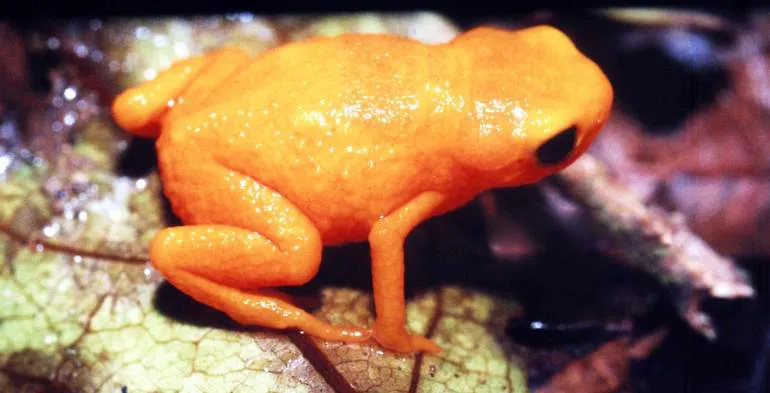
Brachycephalus ephippium, the pumpkin toadlet, is a tiny frog of the family Brachycephalidae, endemic to the Atlantic Forest of southeastern Brazil, in the states of Espírito Santo, Rio de Janeiro, São Paulo and Minas Gerais. Its bright colouring makes it conspicuous on the leaf litter despite its small size.
Identification
Brachycephalus ephippium is a very small frog: adults reach 12.5-19.7 mm in snout-vent length, with newly hatched young about 5.25-5.45 mm long. At that size, a fully grown adult is still shorter than a fingernail.
Habitat and range
The species lives in the Atlantic Forest of southeastern Brazil, across the states of Espírito Santo, Rio de Janeiro, São Paulo and Minas Gerais. Within that forest, it is a diurnal, leaf-litter dweller on the floor of the rainforest, found at elevations of 200-1,250 m.
Behaviour and breeding
Being active during the day sets Brachycephalus ephippium apart from many other small forest frogs, which tend to be nocturnal. It feeds on tiny invertebrates and breeds by direct development: the female lays a few eggs on land, and these hatch straight into young toadlets with no tadpole stage. Newly hatched young are brown and well camouflaged, while adults are bright yellow-orange.
Conservation
The IUCN category is shown in the facts box above. Brachycephalus ephippium’s known range is confined to the Atlantic Forest, a biome under long-standing pressure from deforestation and fragmentation.
Similar species
Brachycephalus ephippium belongs to the genus Brachycephalus, within the family Brachycephalidae, a group of frogs native to the Atlantic Forest and known for extreme miniaturisation. Many of its relatives share the same small size and bright, aposematic colouring.