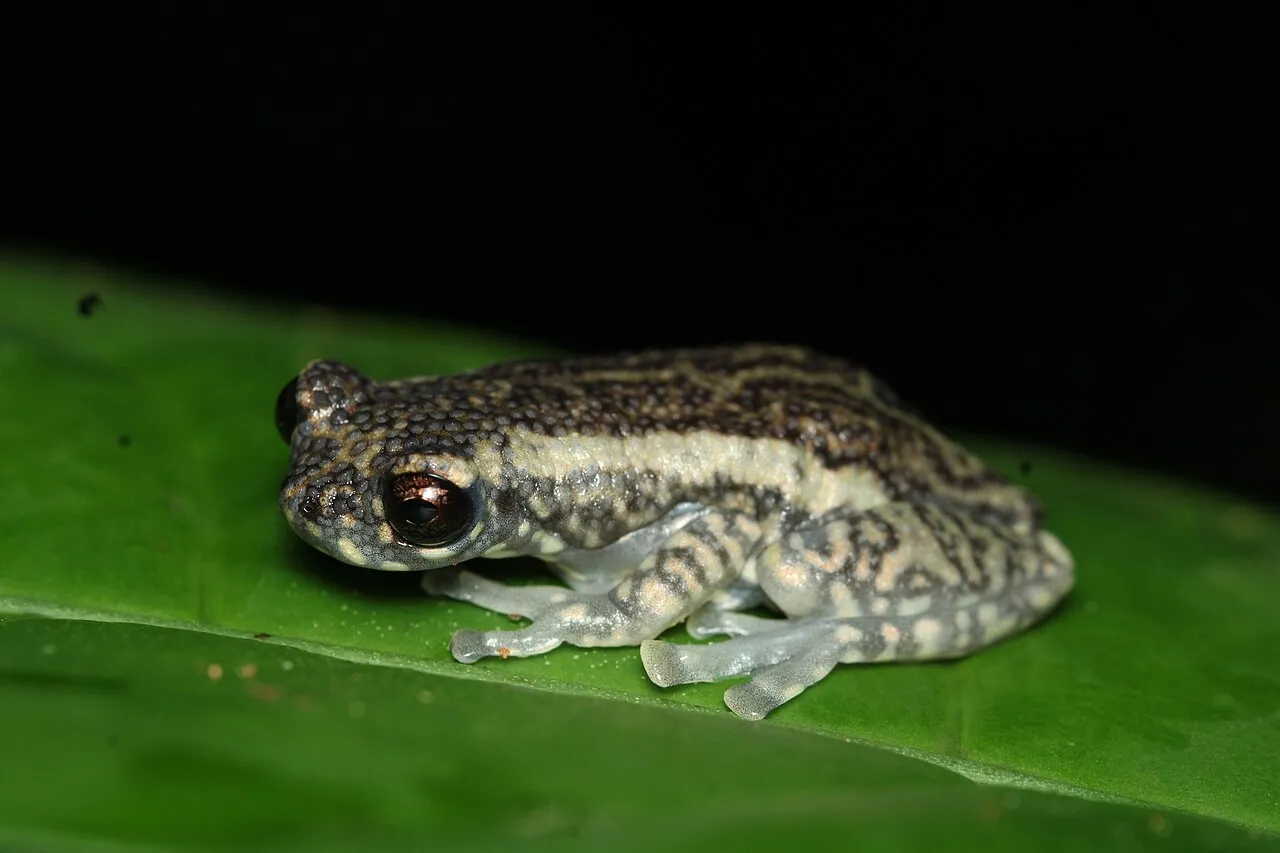
Allophryne ruthveni, the Tukeit Hill frog, is a small amphibian and the type species of Allophrynidae, a family it shares with only two close relatives. It was first described by herpetologist Helen Gaige in 1926, from a holotype collected at Tukeit Hill below Kaieteur Falls, Guyana, the place that gives the species its common name; the type specimen is still held under the catalogue number UMMZ 63419, at the University of Michigan Museum of Zoology. It is found more broadly across the Amazonian region of Guyana, Venezuela, Suriname, Brazil and Bolivia.
Identification
The frog shows one of two colour patterns: it is either black with golden or dull-yellow stripes and spots, or the reverse, a dull-yellow or golden body marked with black stripes and spots. It has a flat body and a small, flat head, a single submandibular vocal sac, and a visible tympanum. Its toe pads are enlarged and wider than its fingers, a trait shared with many climbing frogs, but the last phalanges of its fingers and toes are T-shaped rather than claw-shaped, the feature that separates Allophryne and its relatives from the true tree frogs (family Hylidae) they otherwise resemble. No peer-reviewed snout-vent length figure is confirmed here; AmphibiaWeb, which would normally carry an exact range, could not be reached.
The genus’s taxonomic history reflects how unusual this combination of features is: Allophryne was originally placed in the subfamily Allophryninae within the glass frog family Centrolenidae, and only later phylogenetic work moved it into its own monotypic family, Allophrynidae, confirmed as the sister taxon of the glassfrog clade Centroleninae rather than a member of it.
Habitat and range
The species lives in sparse lowland forest across its Amazonian range, from the type locality at Tukeit Hill below Kaieteur Falls in Guyana through Venezuela, Suriname, Brazil and Bolivia. In Venezuela the records sit south of the Orinoco River, in Amazonas state around Surumoni and in Bolívar state across the upper Caura and upper Paragua rivers, the Sierra de Imataca, San Martín de Turumbán, the Cuyuní area and the upper Uey River, a spread that shows the species tracking continuous forest rather than any single river system. Within that forest it is semiarboreal, spending part of its time 1–3 m up in trees and part on the ground, a habit that likely limits it to forest with enough open structure for both strategies.
Behaviour and breeding
Allophryne ruthveni is an explosive breeder, taking advantage of small ponds that form on the forest floor after rain rather than relying on permanent water. This ties its breeding activity to the Amazonian rainy season and to patches of forest where rainfall pools rather than draining away, and it means sightings cluster sharply around rain events rather than spreading evenly through the year.
Conservation
The IUCN category is shown in the facts box above, assessed as least concern in 2004. No specific threats to Allophryne ruthveni are confirmed here, but the species’ own forest dependence is a clue to its main vulnerability: it inhabits sparse forest and may be restricted to forested areas, avoiding cleared land, so deforestation across its Amazonian and Guianan range is the pressure most likely to affect it over time. That range remains wide, confirmed across Guyana, Venezuela, Suriname, Brazil and Bolivia rather than confined to one small forest patch.
Similar species
Allophryne ruthveni is one of only three species in the monotypic family Allophrynidae, alongside Allophryne relicta, described in 2013, and Allophryne resplendens, described in 2012; the family as a whole is the sister taxon to the glassfrog subfamily Centroleninae and closely related to Leptodactylidae. The two relatives sit at opposite edges of the genus’s known range: Allophryne resplendens comes from Peru’s upper Amazon, while Allophryne relicta was described from the Mata Atlântica forest of Brazil, far outside the Amazonian lowlands where Allophryne ruthveni itself lives. All three species share the genus’s T-shaped finger and toe phalanges, the detail that distinguishes them from the true tree frogs they otherwise resemble at a glance; Allophryne ruthveni itself is the only one of the three confirmed from Guyana, Venezuela, Suriname, Brazil and Bolivia. A further, still-undescribed Allophryne population reported from Peru points to the genus being more widespread than its three named species suggest, consistent with a once more continuous Amazonian range now reduced to scattered relict populations.